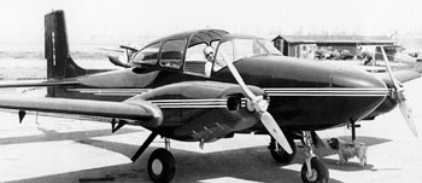
The Camair flew for the first time in 1953 and was designed to meet the requirements of the Cameron Iron Works. The company was so pleased with the results of the prototype (powered by two 225 hp Continentals) that it decided to produce similar conversions of the Navion single-engine airplane on a commercial
basis.
The designation Camair 480 indicates the combined power of the twin 240 hp Continental powerplants used in the production model. Starting with a North American/Ryan Navion, structural modifications were carried out to allow for the increased horsepower and weight of the two engines, while aerodynamic, comfort, and styling refinements were added, including increased fin and rudder area, a longer fuselage nose, and two 29 Imp.Gal wingtip tanks. Building of new aircraft was suspended; however, the Camair Aircraft Corp. continued to supply spare parts to Twin Navion owners.
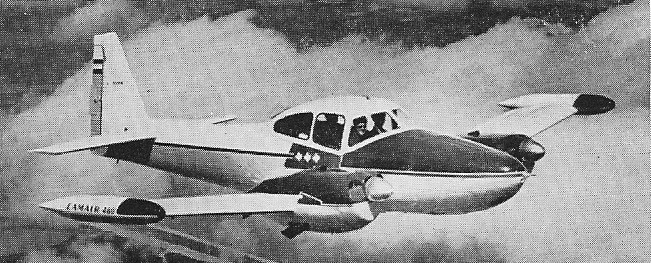
In all, four models were built: the Model A prototype with two 225 hp Continentals, the Model B with twin 240 hp Continentals, the Model C with twin 260 hp Continentals, and the Model D with two 300 hp Continentals.
480
Engines: 2 x Continental O-470-B, 240 hp
Span: 34 ft approx.
Length: 27 ft 11 in
Empty weight: 2730 lb
Loaded weight: 3930 lb
Cruise 75 %: 192 mph
ROC: 1750 fpm
Service ceiling: 22,000 ft
Range: 900 mi
D
Engines two 300 hp fuel-injected Continentals
Gross wt. 4,500 lb
Empty wt. 3,000lb
Fuel capacity 188-200USG
Top 215 mph
Cruise 200 mph
Stall 60 mph
Initial climb rate 2,000fpm
Ceiling 22,000ft
Range 900sm
Takeoff run 400ft
Landing roll 600ft
Seats 4
 All Aero