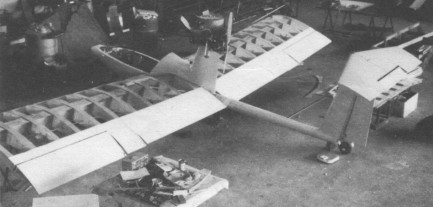
Single seat twin engined mid wing monoplane with conventional three axis control. Wing has unswept leading and trailing edges, and constant chord; T tail. Pitch control by fully flying tail; yaw control by fin mounted rudider; roll control by one third span ailerons; control inputs through stick for pitch/roll and pedals for yaw. Cantilever wing; wing profile Worthmann FX 63 137; double surface. Undercarriage has two wheels in tandem with wing tip skids; steel spring suspension on tailwheel and oleo-pneumatic suspension on main wheels. Push right go right tailwheel steering connected to yaw control. Brake on main wheel. Glass fibre/Kevlar fuselage, totally enclosed. Engines mounted above wing driving tractor and pusher propellers. Wing and T tail are also made with carbon and glass fibre, Kevlar and Dacron covered.
A twin engined push pull aircraft, the Epervier descends in a direct line from his earlier Libellule. This prototype is a cross-country microlight, capable of covering 522 mile (840km) on one engine at economic cruise. The consumption of the Konig SC340 tri cylinder is 1.6 US gal/h (1.3 Imp gal/h, 6.0 litre/h) with the Epervier cruising at 40mph (65 kph). The Epervier can also be regarded as a motor glider with a glide ratio of 20/1 at 34 mph (55 kph), thanks to its Worthmann FX63 137 wing profile combined with a NACA0012 profile for the empennage. In addition to the ailerons, this wing is also fitted with three position flaps acting as flaps at 2o and 15 o and air brakes at 70 o camber.
The construction of the prototype, designed at the end of 1981, was first seen during the summer of 1982, the first flight being made in May 1983.
 All Aero