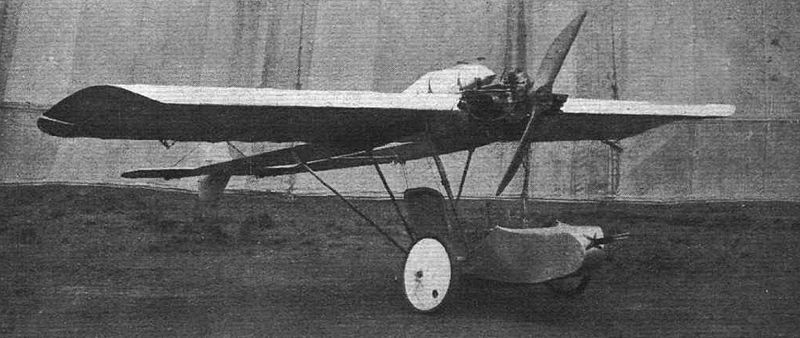
The smallest of designs from Frederick Koolhoven when he worked for the British Aerial Transport Company was the F.K.28 Crow.
The B.A.T. Crow monoplane was built in 1919. It was very small and light. Its tail surfaces were carried by two slim booms. An ABC Gnat 2-cylinder horizontally-opposed engine – together with fuel and oil tanks – was mounted in a pusher configuration on the wing centre section. The pilot’s seat was set between the landing gear suspended below the wing. It was designed to be dismantled for road-transport with the removal of twelve bolts. It was displayed at the First Air Traffic Exhibition in Amsterdam, but it did not fly until some time later. It only flew once and proved to be underpowered. It was scrapped in 1920.
Powerplant: 1 × ABC Gnat, 40 hp (30 kW)
Propeller: 2-bladed fixed-pitch
Wingspan: 15 ft 0 in (4.57 m)
Length: 14 ft 0 in (4.27 m)
Height: 4 ft 6 in (1.37 m)
Empty weight: 220 lb (100 kg)
Gross weight: 400 lb (181 kg)
Maximum speed: 75 mph (121 km/h, 65 kn)
Range: 150 mi (240 km, 130 nmi)
Endurance: 2 hours
Crew: 1
 All Aero