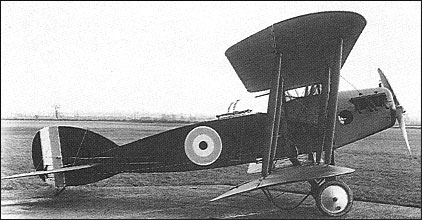
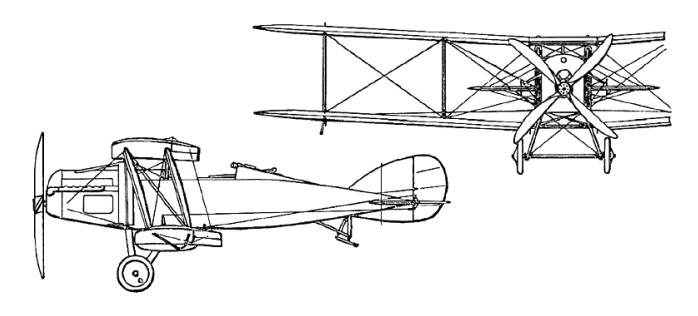
In March 1916 the design was begun of a 120 hp Beardmore powered tractor replacement for the B.E. pusher scouts. The type was desig¬nated R.2A and was intended to be armed with one wing mounted Lewis machine gun and another for the observer on a Scarff ring. At the same time a similar design using the 150 hp Hispano Suiza was produced, but lack of power from the Beardmore caused the designer, Captain Frank Barnwell, to produce a new design using the new 190 hp Rolls Royce Falcon and with the designation F.2A. This was an unequal span two bay biplane with its fuselage, tapered to the rear mounted mid way between the wings.
The first of two prototypes was flown on 9 September 1916, one with the Rolls¬-Royce engine, the other with the 150 hp Hispano Suiza. After successful trials a first batch of 50 Rolls Royce powered pro-duction F.2As was ordered on 28 August armed with a single forward-firing 0.393 Vickers machine gun controlled by a Constantinesco interrupter mechanism to fire through the propeller arc, and either single or twin 0.303 Lewis machine guns on a Scarff ring in the observer’s position.
Deliveries began early in 1917 and it entered service in March 1917 as the first British two-seat fighter. Compared to single-seat fighters of the day such as the Sopwith Pup and Camel the Bristol Fighter was huge, with a wingspan of almost 40 feet and weighing almost a ton fully loaded. Initial operational experience in April 1917 was disappointing, due to the combat techniques used. Confidence in the type was restored when newly-evolved methods were proved successful.
Meanwhile, the improved model had been evolved, the 51st and subsequent production aircraft being of this standard, and delivery of the F.2B resulting in the withdrawal from frontline use of the F.2A.
Take-off weight: 1210 kg / 2668 lb
Empty weight: 783 kg / 1726 lb
Wingspan: 11.96 m / 39 ft 3 in
Length: 7.87 m / 25 ft 10 in
Height: 2.89 m / 9 ft 6 in
Wing area: 36.14 sq.m / 389.01 sq ft
Max. speed: 177 km/h / 110 mph
 All Aero