
The prototype of this single-seat all-metal fighter flew for the first time in December 1937.
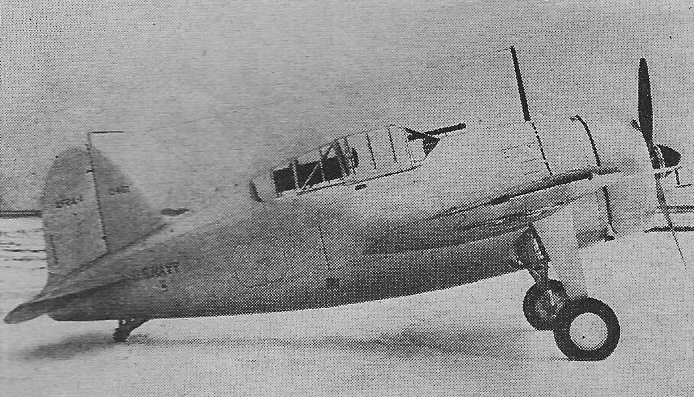
The first production version was the F2A-1 powered by a 700.4kW Wright R-1820-34 radial engine which went into service with the US Navy in 1939. From the initial order of 54, only 11 were actually accepted into service with US forces. The eleven were operated by the US Navy on board USS Saratoga and 44 were exported to Finland. The F2A-1 was the US Navy’s first monoplane fighter.
These were followed by 43 894kW R-1820-40-engined F2A-2 and 108 F2A-3 for the US Navy. Addition of armour plate on the F2A-2 version reduced any performance advantage the basic Buffalo may have had over Japanese fighters.
A contract was placed by the RAF in 1939 for 170 Brewster Model 339’s (called Buffalos) to be operated as a land fighter. Meanwhile a few fighters had reached Belgium and others were in service in the Netherlands East Indies and with the RAF.
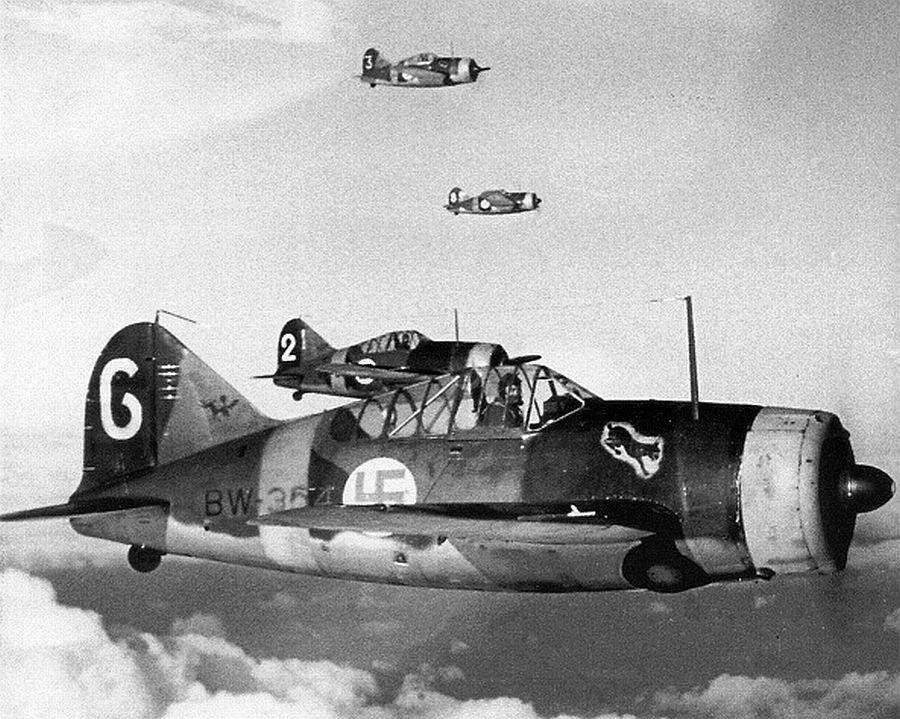
Finland bought 44 Brewster 239 from USA 1939-1940. Basically 43 Brewsters were on sale (US Navy order was 54 and only 11 was delivered). But Finland bought 44 and 38 came from US Navy order and six from Belgium order. Since Belgium has ordered Brewster 339, the factory had to make rather big modification to front fuselage.
After the Russian invasion of Finland in 1940, slowly reinforcements began to arrive for the Finnish air force. The first to come were 5 Gloster Gladiators, 12 Hurricanes, 17 Lysanders and 24 Blenheims, all from Britain. After that, 76 Morane-Saulnier and Koolhoven F.K. fighters arrived from France. Italy sent 17 Fiat fighters, Sweden 12 Gloster Gladiators, and the USA 44 Brewster Buffalo, of which however only 5 reached Finland in time. Even the Union of South Africa sent 25 Gloster Gladiators. Pilots and ground personnel from a number of countries also volunteered to assist them.
Apart from the Finnish fighters which fought well against the Russians, F2A were used almost exclusively against the Japanese and in all cases met superior aircraft. Heavy British losses in the Far East led to their withdrawal and US Navy action during the Battle of Midway was equally unsuccessful as 13 out of the 19 available Buffalos were lost to enemy fire.
In an attempt to improve performance against the Japanese Zero, the .50 in mgs were replaced by .303s and the number of rounds reduced to 350. The fuel was restricted to 80 gallons.
A total of more than 500 F2A were built.
In 1939, following requests by the Finnish Embassy in Washington, D.C., a total of forty-four U.S. Brewster F2A-1 “Buffalo” aircraft that were originally intended for the U.S. Navy were diverted at the behest of the U.S. State Department to Finland for use by the Finnish Air Force (FAF) and designated by Brewster as the Model B-239E. They were flown at first during the Winter War of 1939-40 between the Soviet Union and Finland. There they were never referred to as the “Buffalo” by the FAF, but merely “Brewster” or by nicknames such as “Sky Pearl” and “Pearl of the Northern Skies” and “Butt-Walter” (or “Pylly-Walter”) and “American Hardware” (American metal) and “Flying Beer Bottle,” and they received FAF serial numbers BW-351 though BW-394 (“BW” aircraft).
The Finns liked the Buffalo enough to design a version called the Humu (‘Reckless’) with a wooden wing and a Russian engine. It proved unsatisfactory in trials and only a single example was built.
The one Brewster 239 (F2A-1) is in The Aviation Museum of Central Finland in Tikkakoski, Finland. There is also the prototype of VL Humu which is the clone of F2A-1 or 239.
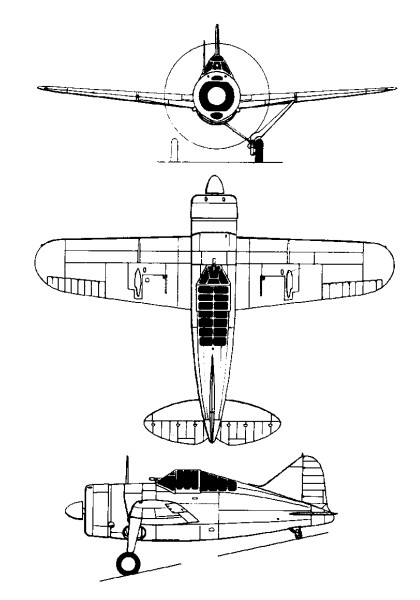
Brewster F 2 A Buffalo
Carrier based fighter aircraft 1938
Length: 26.345 ft / 8.03 m
Height: 12.073 ft / 3.68 m
Wingspan: 35.007 ft / 10.67 m
Wing area: 208.929 sqft / 19.41 sq.m
Max take off weight: 7159.6 lb / 3247.0 kg
Weight empty: 4731.9 lb / 2146.0 kg
Max. speed: 279 kts / 517 km/h
Cruising speed: 224 kts / 415 km/h
Service ceiling: 33202 ft / 10120 m
Wing load: 34.24 lbs/sq.ft / 167.00 kg/sq.m
Range: 839 nm / 1553 km
Engine: Wright R 1820-40 Cyclone, 1184 hp
Crew: 1
Armament: 4x cal.50 MG (12,7mm), 2x 45kg Bomb.
F2A-2
Engine: 1100 hp Wright R-1820-40 (G-205A) Cyclone
Wingspan: 35 ft / 10.67 m
Length: 26 ft 4 in / 8 m
Height: 12 ft 1 in / 3.7 m
Empty weight: 4630 lb / 2100 kg
Loaded weight: 7055 lb / 3200 kg
Max speed: 300 mph / 483 km
ROC: 3070 fpm / 935 m/min
Service ceiling: 30,500 ft 9300 m
Range: 650-950 mi / 1045-1530 km
Armament: 4 x mg, 0.30 in, 0.303 in, or 0.50 in
Brewster F2A-3 Buffalo
Length: 26 ft 4 in (8.03m)
Wingspan: 35 ft 0 in (10.67m)
Height: 12 ft 1 in (3.68m)
Wing area: 19.41 sq.m / 208.93 sq ft
Maximum Speed: 321mph (517kmh; 279kts)
Cruise speed: 415 km/h / 258 mph
Maximum Range: 965miles (1,553km)
Rate-of-Climb: 3,070ft/min (936m/min)
Service Ceiling: 33,202ft (10,120m)
Armament:4 x 12.7mm machine guns, 2 x 45-kg bombs
Accommodation: 1
Empty Weight: 4,731lbs (2,146kg)
Maximum Take-Off Weight: 7,158lbs (3,247kg)
Engine: 1 x Wright R-1820-40 cyclone radial piston , 895kW
 All Aero