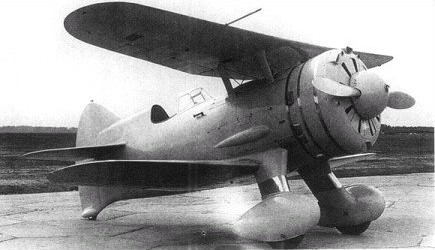
After eight months from the destruction of the “7211”, Borovkov and Florov were called to Moscow, where it was proposed to them to continue the development of the original biplane. On 13 September 1938 both builders presented a new preliminary draft of its Object 7 changed this time with a Tumansky M-88 1000 hp engine and sealed cabin.
The project was reviewed and approved, but soon the director of Factory No.21 reported that building a new experimental model in his factory would be impossible due to the lack of productive capacities and requested that the new model be removed from his development plan. In this situation Borovkov and Florov were instructed by GUAP to gather as few personnel as possible and move to the territory of Factory No. 207 located in the city of Dolgoprudni, near Moscow. In this new facility these engineers continued their developments, building several biplanes that became known as I-207.
Factory No.207 was created with the objective of producing airships, which is why it was commonly known as “Dirizhablestroi” and at that time it presented a lot of problems. The construction of the military airship DP-16, conceived for the air defense of Leningrad, was progressing with difficulties, for which the factory managers received constant reprimands and sanctions. By early 1938 the arrests had begun, which included the factory manager and several workers. The new principal Gorin had too many problems to solve and therefore paid too little attention to the new builders.
It was practically not until April 1939 that work began on Borovkov and Florov’s new fighter. Initially, two copies were built, both under the name I-207 (Factory Hunting No.207). The first specimen had an M-62 engine and was named “Object 7” No. 1 (I-207/1).
The three prototypes delivery date were set as September, October and November 1938.
Borovkov served as head of the factory’s building and drawing department (ChKO) (sometimes also called series monitoring department or CKO) and Florov headed a group of builders directly subordinate to NN Polikarpov, so in fact he could be considered main factory builder. The position of NN Polikarpov towards the new fighter was known.
In the summer of 1938, the advances in the new fighters of Borovkov and Florov were little. Kaganovich decided to appoint Mikhail Pashinin as the main builder of Factory No.21, who came to Gorky not only with the task of directing, but with the idea of building his own fighter model here.
Under these conditions, Borovkov and Florov were given the option of setting up their own production base at Factory No. 207 located in the city of Dolgoprudni, on the outskirts of Moscow. They were allowed to take only 12 collaborators with them. After a visit by Yakov Vladimirovich Smushkievich, it was decided to start work on the new fighter prototypes.
The first example, with a Shvietsov M-62 engine, was designated at the factory “Object 7 No.1” or I-207/1.
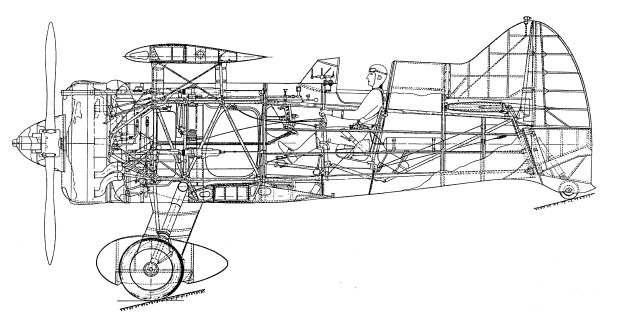
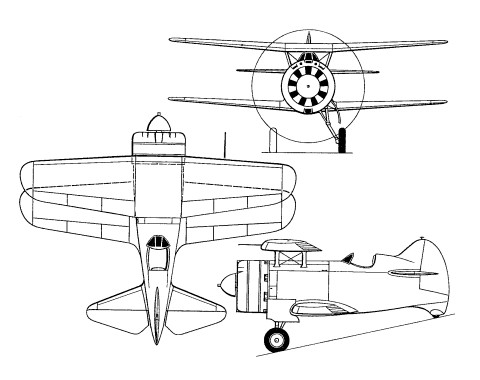
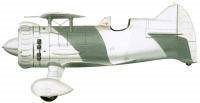
The I-207/1 was generally similar to the “7211” prototype. It kept the fixed landing gear and fairing, but introduced a somewhat longer fuselage, the windshield was fixed in the open cockpit, and a number of constructive improvements.
The fuselage featured mixed construction. The central part, which connected to the engine, was designed of welded steel tubes (30JGSA), covered with easily removable thin metal sheets, which facilitated maintenance and repair actions. In this central section the wings were fixed. The tail section was constructed of wood with a monocoque structure built with birch veneers on a lightweight skeleton, similar to that used on the I-16.
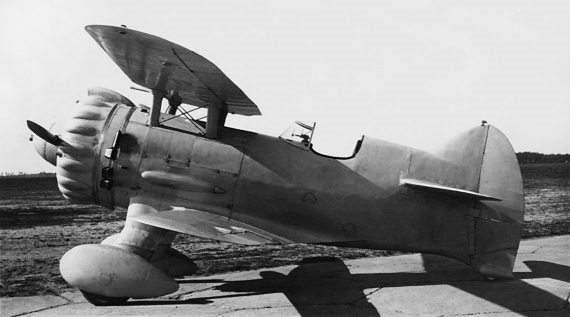
The wings were 14% thick at the wing and 6% at the ends and featured an all-metal construction with a smooth coating and great aerodynamic cleanliness.
Both wings had the same dimensions. The structure was covered with corrugated metal in layers to which smooth 0.5 mm duralumin sheets were attached, forming a honeycomb-like structure. The wing upper surface had two layers of corrugated metal, one 1 mm and the other 0.8 mm. Only a 0.8 mm thick corrugated duralumin layer was used on the soffit.
By using the coating as a structural component, the resistance was considerably increased, while achieving a noticeable reduction in weight. This also allowed the stringers to be eliminated, preserving only the metal ribs obtained by pressing. The wing weight on the NII VVS returned a relative weight of only 13.6 kg / m².
The upper wing featured flaps and was fixed to the fuselage structure by 4 short supports reinforced with steel turnbuckles. The lower wing contained the ailerons and braking surfaces.
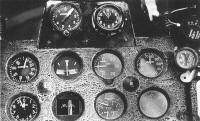
The 850-hp, air-cooled M-62 radial engine was selected as the power plant, covered by a hood that highlighted the fairings for the cylinder heads and lacked the side gates. An air intake was added in the upper part. A VISh-26 propeller with 2 blades and 2.8 m in diameter was selected. The small size of the aircraft did not allow for a larger propeller.
The I-207/1 kept the cockpit moved rearward in order to improve the pilot’s visibility. This lacked protection, although it was considered that the radial engine should guarantee adequate protection in frontal encounters.
The landing gear was designed as a fixed type with the wheels and the landings fairings, introducing a tail wheel at the base of the rudder to replace the original 7221 skid.
The armament consisted of four ShKAS 7.62 mm machine guns with 2,200 rounds.
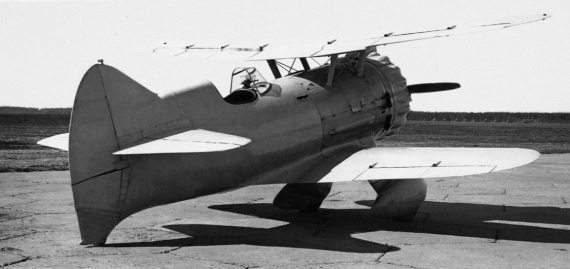
I-207/1 was taken to the airfield in June 1939. On the 29th of June, the test pilot LM Maximov made the first flight. Joint testing (factory and acceptance) at the NII VVS lasted until October 2nd. Apart from LM Maximov, the prototype was also flown by PM Stefanovski. The document with the conclusions was signed by MM Kaganovich and AD Loktionov on October 5.
The expected top speed of 490 km / h could not be reached. The I-207/1 reached only 437 km / h at a height of 4750 meters. In general, in all its aspects the I-207/1 was comparable to the Polikarpov I-153 and against it it was compared. Using the same Shvietsov M-62 engine, the I-207 was heavier at 213 kg. The turn time was 19 – 20 seconds against the 13 – 14 reached by the I-153, while in relation to the ascent speed the I-207 reached 5000 meters in 6.2 minutes (0.5 minutes less than the Polikarpov fighter).
The I-207/1 was found to have no advantages over Polikarpov’s biplane and maneuverable fighters and the I-153 was already in series production. It was also noted that the fixed landing gear was obsolete and affected performance. The small dimensions of the plane made it necessary to use a very small diameter propeller, which could only be solved with a reducer that allowed to increase the revolutions.
Despite this, the excellent flight and operating characteristics of the I-207 were recorded and it was recommended to develop a small series with the aim of achieving a reduction in weight, installing retractable landing gear and increasing maximum speed. With a retractable undercarriage, the I-207 was predicted to be similar to or superior to the Polikarpov I-153.
The purpose of the I-207/2 was to serve as a backup to the I-207/1 evidence, which is why in the documents of the time it was called “dublior” or duplicate.
The second example, called “Object 7” No. 2 (I-207/2) was built with an M-63 engine. Both examples were characterized by having fixed landing gear and were fundamentally different from the 7211 prototype in presenting an elongated fuselage and constructive improvements. One of the main characteristics of the model was its high technological level, designed to facilitate the production process.
The I-207/2 was generally similar to the I-207/1. It kept the fixed landing gear and fairing and the windshield was fixed in the open cockpit, but with small differences in its construction.
The fuselage featured mixed construction. The central part, which connected to the engine, was conceived of welded steel tubes (30JGSA), covered with easily removable thin metal sheets, which facilitated maintenance and repair actions. In this central section the wings were fixed. The tail section was constructed of wood with a monocoque structure built with birch veneers on a lightweight skeleton, similar to that used on the I-16.
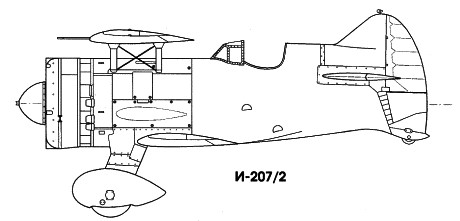
The wings were 14% thick at the wing and 6% at the ends and featured an all-metal construction with a smooth coating and great aerodynamic cleanliness.
Both wings had the same dimensions. The structure was covered with corrugated metal in layers to which the smooth sheets of duralumin were fixed, forming a honeycomb-like structure. Unlike the I-207/1, the coating was made with 0.8 mm sheets. The wing upper surface had two layers of corrugated metal, one 1 mm and the other 0.8 mm.
Only a 0.8 mm thick corrugated duralumin layer was used on the soffit. By using the coating as a structural component, the resistance was considerably increased, while achieving a noticeable reduction in weight. This also allowed the stringers to be eliminated, preserving only the metal ribs obtained by pressing. The wing weight on the NII VVS returned a relative weight of only 13.6 kg / m².
The upper wing featured flaps and was fixed to the fuselage structure by 4 short supports reinforced with steel turnbuckles. The lower wing contained the ailerons and braking surfaces.
The M-63 air-cooled radial engine with a nominal 930 hp, covered by a NACA hood with skirt-type side gates, was selected as the powerplant. The installation further ahead of the M-64 and M-65 engines, obtained as a development of the M-63, was also envisaged. The fuel system in this specimen was modified, since by increasing the wing drag it was possible to place the initially projected fuel tank in the upper wing.
The I-207/2 kept the cockpit moved rearward in order to improve the pilot’s visibility. This lacked protection, although it was considered that the radial engine should guarantee adequate protection in frontal encounters.
The landing gear was designed as a fixed type with fairings and wheels. The tail wheel was also faired.
The armament consisted of four ShKAS 7.62 mm machine guns with 2,200 rounds.
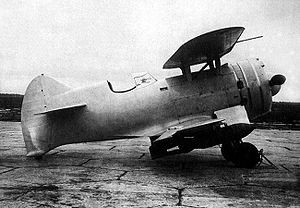
State testing of this model took place between 17 September 1939 and 22 May 1940. Nikolayev (for the NII VVS), Maximov (for Factory No.207), Kubyshkin and Stefanovski were selected as test pilots. A total of 22 flights were flown with a total of 12 hours. The tests showed that the manoeuvrability of the aircraft was not satisfactory. The turn time at 1000 meters was 18 – 18.8 seconds instead of the requested 12 seconds. The ascent time to 8000 meters was 15 minutes against the 8 established in the requirements. Top speed only reached 422.5 km / h. With these terrible results, the rest of the benefits were not even tested.
The test report found that despite the increase in power from the new engine the results were generally lower than those obtained with the I-207/1, so the result was unsatisfactory and soon the interest in this prototype disappeared. It was dismantled shortly before the war.
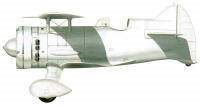
Only shortly after starting the construction of the two “Object 7” at Factory No.207 began construction of an improved model which was designated “Object 8 No.3” and later I-207/3. This prototype introduced a significant number of improvements, among which the retractable landing gear and a motor with reducer stood out (which could not be installed because it was not available). The I-207/3 was generally similar to the I-207/2.
The fuselage featured mixed construction. The central part, which connected to the engine, was conceived of welded steel tubes (30JGSA), covered with easily removable thin metal sheets, which facilitated maintenance and repair actions. In this central section the wings were fixed. The tail section was constructed of wood with a monocoque structure built with birch veneers on a lightweight skeleton, similar to that used on the I-16.
The wings were 14% thick at the wing and 6% at the ends and featured an all-metal construction with a smooth coating and great aerodynamic cleanliness.
Both wings had the same dimensions. The structure was covered with corrugated metal in layers to which the smooth sheets of 0.8 mm duralumin were fixed, forming a honeycomb-like structure. The wing upper surface had two layers of corrugated metal, one 1 mm and the other 0.8 mm.
Only a 0.8 mm thick corrugated duralumin layer was used on the soffit. By using the coating as a structural component, the resistance was considerably increased, while achieving a noticeable reduction in weight. This also allowed the stringers to be eliminated, preserving only the metal ribs obtained by pressing. The wing weight on the NII VVS returned a relative weight of only 13.6 kg / m².
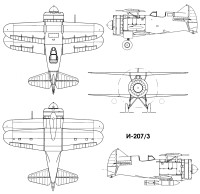
The upper wing featured flaps and was fixed to the fuselage structure by 4 short supports reinforced with steel turnbuckles. The lower wing contained the ailerons and braking surfaces.
As a power plant, it maintains the M-63 radial engine with air cooling and nominal 930 hp, covered by a NACA hood with inlet regulation windows and skirt-type side doors. The selected propeller was the 2.8 m AV-1 two-blade automatic.
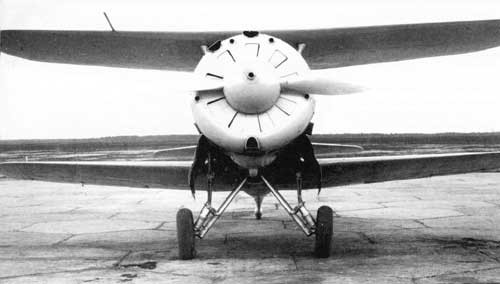
The landing gear was designed of the retractable type, maintaining the conventional design with a faired tail wheel. The main landers were constructed of chrome-plated steel tubes. The retraction system was novel, or at least unusual, because instead of retracting into the wing or fuselage by pivoting over a point, these landers did so by rising vertically until they were covered inside the fuselage. Once the undercarriage retracted, the opening was covered with a fairing. The tail wheel was fixed.
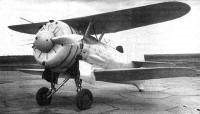
The I-207/3 kept the cockpit open and moved rearward in order to improve the pilot’s visibility. The armament consisted of four ShKAS 7.62 mm machine guns with 2,200 rounds.
I-207/3 was built between June 1939 and April 1940. In compliance with NKAP order No. 124 of April 22, 1940, the state tests of this model were started. These tests took place between April 22 and June 7 at the NII VVS and comprised 30 flights with a total duration of 13 hours and 20 minutes. These flights were executed by pilot LM Maximov.
During the tests, the excellent speed of 486 km / h at 5000 meters was reached and the turning time decreased to 17 seconds (still higher than the 12 requested). These values were already interesting. Due to its results, the I-207/3 surpassed the I-16 of the latest versions in all its characteristics. It was considered that with the installation of the new M-64 or M-65 engines, the maximum speed could be brought to 550 km / h.
The I-207/3 demonstrated excellent stability and a very good response to controls at all speed ranges. Take-off and landing operations were straightforward and the plane kept the course smoothly. The chopping was carried out with great stability and it was easy to get out of the augers. The aircraft was undemanding to maintenance and steps had been taken to facilitate service.
On the other hand, the introduction of the retractable undercarriage decreased the weight of the aircraft, solving an old model problem. This made it possible to use the aircraft for other tasks by being able to increase the payload capacity with fuel or bombs.
The Winter War with Finland demonstrated the importance of having punctual bombing planes, capable of attacking specific objectives such as bridges, railway junctions, buildings and military objectives. The VVS launched a call to urgently develop dive bombers capable of accomplishing these tasks.
Borovkov and Florov, realizing that the biplane design had lost its moment as a fighter, decided to seize this opportunity. Vaxmistrov had developed a version of his Zvenó that used two Polikarpov I-16 fighters under the wings armed with two FAB-250 bombs. Modifications to these attack I-16s were made at Factory No.207 itself. With the new changes, the I-207 presented the ability to carry the same armament, overcoming some of the limitations of the monoplane fighter.
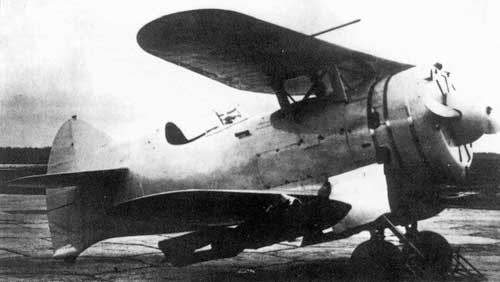
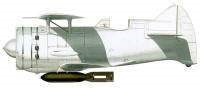
The I-207/3 was urgently modified, providing it with underwing supports for two FAB-250 bombs. The tests of the airplane took place between September and October 1940 and in them it was possible to demonstrate the feasibility of the model for this task.
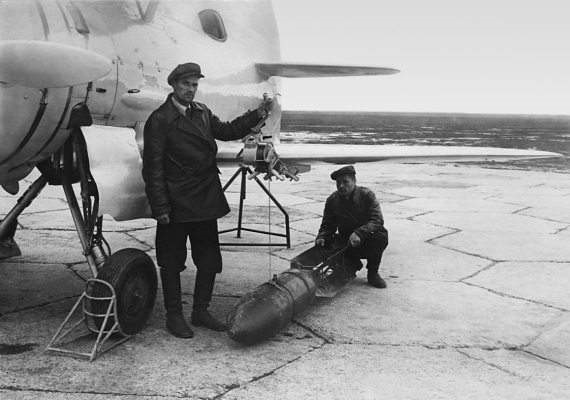
Unlike the I-16, which lacked the power to take flight with the two bombs, the I-207 could take off with this load without difficulty, maintaining stable flight and good control. The dive for the bombardment was carried out at angles of 70º. It was proposed to increase the firepower by replacing the ShKAS machine guns with others of greater caliber without affecting the weight, as well as to assess the possibility of using non-directed rockets.
During the development of the tests, the NII VVS was visited by Kliment E. Voroshilov, who positively assessed the aircraft and promised to obtain authorizations to build a series of 200 copies.
Despite Voroshilov’s promise, it was not mass-produced due to its poor range, which at that time was considered essential for a bomber.
Despite the gain in benefits, “Object 8” was already unable to meet the demands of 1940. Although its speed could already be considered superior to the latest modifications of the Polikarpov I-16, it was surpassed by almost 100 km by the new Yak, MiG and LaGG monoplane fighters.
For this reason, and in order to increase performance, the I-207/3 was used as a test bed for the DM-4 ramjet designed by IA Merkulov. This auxiliary power plant used the same fuel as the piston engine. Two units were installed under the lower wing, in the position of the supports.
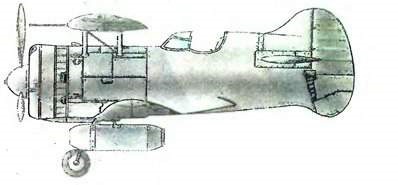
During the tests it was found that with these engines turned off, the speed of the aircraft decreased by 12 km / h, due to the increase in aerodynamic resistance. With the engines running, the increase achieved was about 24 km / h. it was not really much, but calculations showed that this gain increased if the aircraft was accelerated before turning on the auxiliary engines. Around 20 flights were made without any accident occurring.
Taking into account the experience of the I-207/3 tests, between the end of 1940 and the beginning of 1941 at Factory No.207 a new version of the I-207 known as “Object 9” or “Deviatka” was built. Shortly afterwards it received the denomination I-207/4 and in some literature it has been named I-209, although this name was never official.
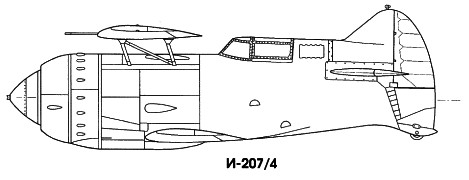
This model was designed to use the M-65 engine and was to serve in manoeuvrable fighter and dive bomber roles. The use of the M-64 and M-65 engines should allow achieving the desired speed of 550 km / h.
The “Object 9” project was essentially completed by May 1, 1940, but its construction ran into a number of problems. The I-207 fighter was removed from the aircraft industry’s experimental construction plan for 1940. The financing was cancelled and the workers assigned to its construction were redirected to other activities.
Borovkov and Florov were forced to go to the headquarters, achieving a meeting with the new Commissioner Shajurin. The introduction of the model as a dive attack aircraft sealed its fate and approval was soon obtained for further development.
The I-207/4 attack was designed in two versions; with fixed gear and with retractable gear. The fundamental reason for this decision was given by the results of the calculations depending on the load. The retractable train provided better performance and could guarantee the dive bombardment of two 250 kg or four 100 kg bombs, but in order to transport a 500 kg bomb in the center of the fuselage it was considered necessary to keep the train fixed. The armament also included two 12.7 mm machine guns.
According to the calculations, the version with the retractable train had to develop about 470 km / h at 6500 – 7000 meters and 405 at sea level. The 7000 meters could be reached in 9.5 minutes.
The fixed undercarriage version with a 500 kg bomb delivered a calculated speed of 396 km / h at altitude and 350 km / ha at sea level. The ascent time to 7000 meters was calculated to be 19 minutes.
Eventually neither the M-64 nor the M-65 were produced, so the manufacturers were forced to settle for the Shvietsov M-63R (M-63AR) engine with an elongated shaft and a reducer. This made it possible to modify the shape of the nose, thereby improving aerodynamics.
The I-207/4 was fitted with a three-meter diameter VISh three-blade propeller. The cabin of this version was conceived closed with the cover opening to one side. The landing gear remained retractable type.
Under the wings it could carry two FAB-250 or four FAB-100 bombs. The conceived armament included two 12.7 mm BS machine guns, although it is not known that they could have been installed.
The I-207/4 was finally built in the spring of 1941 and made several flights, but by this time the interest in the biplane configuration had disappeared and with the start of the war the tests were never finished. The last prototype of the I-207 fighter built.
The fate of the prototype fighters built was as follows: The I-207/2 ended up serving as an experimental aircraft in the TsAGI’s T-104 wind tunnel tests. The I-207/3 with retractable undercarriage was for some time based at the LII airfield in Ramenskoye until it was damaged. After repairs, this plane received a ramjet engine designed by Merkulov, making about twenty flights.
It was proposed to deliver the first two airplanes (with fixed train) to the Moscow air club of the MAI, but the director of the LII, MM Gromov categorically opposed it, considering that the I-207 was too complex a plane to be used in sports flights. Finally in the autumn of 1940 the substitute of the commissioner of the aeronautical industry for experimental aviation, AS Yakovlev, decided to deliver these two copies as a static exhibition at the MAI. At the beginning of the war, it was decided to dismantle the exhibited specimens and all their useful elements to donate them to the industry. This was the final destination of the I-207.
I-207/1 / Object 7
Powerplant: Shvietsov M-62, 800 hp and 930 hp at takeoff
Wingspan: 7.00 m
Wing area: 18.00 m²
Length: 6.34 m
Empty weight: 1622 kg
Loaded weight: 1950 kg
Flying weight: 1975 kg
Wing loading: 109.7 kg / m²
Power load: 2.0 kg / hp
Maximum speed at sea level: 387 km / h
Maximum speed at 4000 m: 436 km / h
Landing speed: 115 km / h
Ascent time to 5000 m: 6.2 min
Practical ceiling: 9150 m
Spin time: 19.2 sec
Range: 700 km
Take-off run: 196 m
Armament: 4 ShKAS machine guns with 220 rounds
Accommodation: 1
I-207/2 / Object 7
Powerplant: M-63, 930 hp and 1100 hp at takeoff
Wingspan: 7.0 m
Wing area: 18.0 m²
Length: 6.34 m
Empty weight: 1590 kg
Flying weight: 1951 kg
Wing loading: 108.7 kg / m²
Power load: 1.8kg / hp
Maximum speed at sea level: 397 km / h
Maximum speed at 4000 m: 422 km / h
Landing speed: 115 km / h
Ascent time at 5000 m: 6.7 min
Practical ceiling: 9200 m
Spin time: 18.1 sec
Endurance: 2h
Armament: 4 ShKAS machine guns
Accommodation: 1
I-207/3 / Object 8
Powerplant: M-63, 930 hp and 1100 hp at takeoff
Wingspan: 6.98 m
Wing area: 18.00 m²
Length: 6.34 m
Height: 3.46 m
Empty weight: 1521 kg
Flying weight: 1879 kg
Wing loading: 102.7 kg / m²
Power load: 1.7kg / hp
Maximum speed at sea level: 437 km / h
Maximum speed at 2000 m: 453 km / h
Maximum speed at 5300 m: 486 km / h
Cruising speed: 405 km / h
Landing speed: 110 km / h
Ascent speed: 1087 m / min
Ascent speed at sea level: 18.9 m / sec
Ascent speed at 2000 meters: 20.4 m / sec
Ascent time at 5000 m: 4.6 min
Turn time at 1000 m: 17 sec
Practical ceiling: 10,200 m
Practical range at 90% of maximum speed: 500 km
Take-off run: 165 m
Landing run with brakes: 200 m
Armament: 4 ShKAS machine guns with 2200 rounds
Accommodation: 1
I-207/4 / Object 9
Powerplant: M-63R, 930 nominal hp gearbox and 1100 hp at takeoff
Wingspan: 7.0 m
Wing area: 18 m²
Length: 6.98 m
Flying weight: 2215 kg
Wing loading: 123 kg / m²
Power load: 2.0kg / hp
Maximum speed at sea level: 489 km / h
Maximum speed at 5000 m: 583 km / h
Landing speed: 115 km / h
Ascent time to 5000 m: 4.4 min
Practical ceiling: 10,500 m
Range: 640 km
Armament: 4 ShKAS machine guns with 550 rounds per weapon
Accommodation: 1
 All Aero