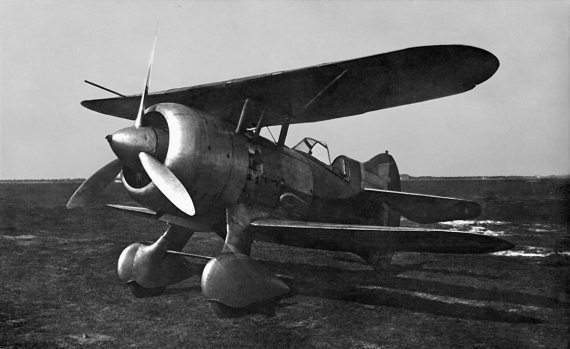
The head of the VVS, Alksnis determined that the Air Force would need both fast monoplane and manoeuvrable biplane, which should complement each other in battle.
To solve these contradictory requirements Florov and Borovkov proposed a biplane wing structure with thin profile wings and totally free of braces or struts. The basis for this idea was supported by the work carried out by IV Ostoslavski which demonstrated the improvement of the lift capacities of the wing by using the air flow generated by the propeller and the work of the German scientist L. Prandtlya on drag.
Based on this reasoning, the idea of two young engineers who proposed to achieve in a single model an airplane capable of combining both potentialities seemed quite attractive and Alksnis decided to support the project. It is noteworthy that in this case there was no governmental or aeronautical industry resolution. Nor did the factory manager, Miroshnikov, have any information on the development.
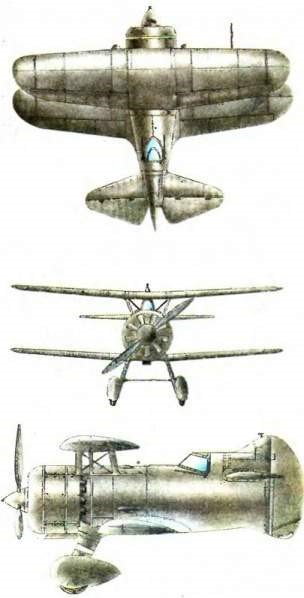
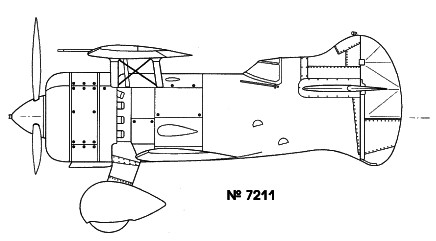
The new model was designed with some influence from the Polikarpov I-16 fighter. This was seen mainly in the profile view of the fuselage, but the similarity between the two planes did not go beyond there. The new aircraft featured the cockpit moved rearward in order to improve pilot visibility. Another notable difference was the smooth coated metal wings and great aerodynamic cleanliness.
These wings, with a wingspan of only 6.98 meters, had a corrugated metal structure to which the smooth sheets of the coating were fixed, forming a honeycomb-like structure, which contributed considerably to the increase in resistance and allowed a significant decrease in weight (the wing weighed only 110 kg and the relative weight was 12.23 kg / m²).
The upper wing was fixed to the fuselage structure by four short supports reinforced with steel tensioners.
The fuselage featured mixed construction. The central part, which connected to the engine, was conceived of welded steel tubes (30JGSA), covered with easily removable thin metal sheets, which facilitated maintenance and repair actions.
In this central section the wings were fixed. The tail section was constructed of wood with a monocoque structure built with birch veneers on a lightweight skeleton, similar to that used on the I-16.
As the power plant, the Tumansky M-85 14-cylinder double-row air-cooled engine was selected, with a power of 800 hp at 3850 meters of altitude. The power plant included a NACA-type hood and a three-bladed propeller.
The cockpit lacked protection, although the radial engine was considered to provide adequate protection against frontal encounters. The windshield was moved forward through rails located on the sides of the fuselage. The aircraft envisioned an armament of four 7.62mm ShKAS machine guns with 2,200 rounds, but was never installed.
The landing gear was designed as a fixed type with fairings and wheels. The tail skid was also faired with the particularity that it was conceived as a continuation of the rudder and could be retracted by compressing the shock absorber.
At the beginning of 1936, a life-size wooden model of the new model was ready. On one of its plywood sides was written in ink in large handwritten letters “Accepted. Alksnis”.
From this moment the production of the prototype began. Its creators called it “Object No.7”, but in official documents the plane was named 7.21.1 (seventh type of Factory No.21, first copy). The process of projection, construction and preparation of the new plane took a few months and only by the end of the year was the prototype ready.
Despite Alksnis’s signature, Object 7 was something “illegal” in the production process and for this reason it was worked on whenever possible and on weekends at Factory No.21, Gorky.
The civil war that began in Spain in 1936 demonstrated the potentialities of the I-15 biplane in combat and soon the interest towards this scheme strengthened. At the end of 1936, Polikarpov was asked for an accelerated upgrade of its biplane with the aim of relaunching its production. The creators of “Object 7” were also pressured, especially considering that the plane was practically finished.
The 7211 was taken to the airfield in March 1937, when the snow began to give way. Between 17 and 19 the first runs were held, but the flights were postponed to May, waiting for the runway to dry out. On 6 May 1937 LM Maximov made the first flight of 15 minutes around the airfield.
Over a month of test flights, the plane accumulated 22 flights. On June 1, 1937, the 7211 was flown by PM Stefanovski, who made a positive assessment of the plane. The ease of piloting, the simplicity of take-off and landing and the excellent stability in all flight regimes were highly valued, which allowed the model to be flown by pilots without great preparation. The rearward shift of the cockpit improved visibility.
In terms of manoeuvrability, the “7211” occupied an intermediate position between the I-15 and the I-16. The turning time at 2000 meters was 14 seconds and the ascent time at 5000 meters was 4 minutes and 37 seconds (for the Polikarpov I-15 it was 6 minutes and for the I-16 it was 7 minutes).
The maximum speed reached at 4000 meters was 416 km / h and was considered insufficient, especially since the calculations were 480 – 500 km / h. However, it was considered that with better construction completion and selection of the propellor the expected results could be achieved.
The Head of the Republican Aviation and the Madrid Air Defense, Yakov Vladimirovich Smushkievich, recently arrived from Spain, was also interested in the model. It was urgently decided to develop state tests and send the aircraft to the NII VVS Shelkovo airfield, outside Moscow. Experienced test pilot Edgar Yuganovich Prieman was selected for this flight.
On June 22, Prieman made the first familiarization flight in the “7211”. This flight was the 24th flight on the plane and ended in catastrophe. After making a first circuit, Prieman had to land, but at the last minute he changed his mind and put power on to make a second circuit. When accelerating, the engine suddenly failed.
The pilot decided to make a sharp turn and the plane, lacking power, ended up crashing into the railway embankment. The nose of the plane was destroyed and the pilot, thrown from his seat, died when his head hit the rails.
The causes of the accident was an obstruction in the carburettor. Despite the fact that it was a known and frequent cause, times were too turbulent and it was necessary to find culprits. The director of Factory No.21, Miroshnikov and the main builder of Factory No.29 of engines in Zaparozhie, AS Sakharov were arrested. Reprisals were also expected towards Borovkov and Florov for their direct relationship with a failed model and, on the other hand, the fate of the model was hanging by a thread.
Several specialists were asked to assess the model. Among them was NN Polikarpov, who harshly criticized the work of the young specialists. A conclusive report of September 28 is preserved with his signature and addressed to AN Túpolev, who at that time was temporarily in charge of the People’s Commissariat for the Defense Industry (NKOP). This report specified:
- The 2711 aircraft has a flight weight of 1475 kg with a total load of 390 kg. According to the calculations, the flight weight should increase by 200 – 250 kg when installing all the flight equipment (electrical, radio, etc.). In this case, a certain weight reduction is proposed thanks to the installation of a lighter M-87 engine. The final figure in this variant according to the calculations of the builders reaches 1800 – 1850 kg. This result is unfounded, the flying weight will not be less than 1935 kg.
- During the tests a ceiling of 6880 meters was reached, however in the calculations the reach curve of the maximum ceiling has been extrapolated to a value of 13000 meters. The use of the expected results in relation to the actual ones obtained leads us to a contradiction.
- The maximum speed obtained is much lower than the calculated one (420 km / h against 490 km / h). One of the exposed causes – poor propeller delivery. A better selection will surely not solve the difference either.
These conclusions by Polikarpov about a disgraced plane could have several interpretations, but scholars agree that the success of “Object 7”, which was built in a factory that produced its models and was preparing to introduce new versions of the I -16 and your new “Ivanov” monoplane, could affect your interests. On the other hand, there may be other personal reasons as the “7211” was developed without your authorization.
Despite these evaluations, towards the end of September the government decision to mass-produce the model 7211 was issued. Unfortunately, and for unknown reasons this authorization never reached Factory No.21 in Gorky. The young builders weren’t in a position to be pushy either, as the project’s main mentor, Alksnis, was arrested in November, making it even better not to create too much noise.
Powerplant: 800 hp Tumansky M-85
Wingspan: 6.98 m
Wing area: 18 m²
Length: 5.88 m
Empty weight: 1,355 kg
Flying weight: 1745 kg
Wing loading: 97 kg / m²
Power load: 2.1kg / hp
Maximum speed at sea level: 365 km / h
Maximum speed at 5000 m: 416 km / h
Landing speed: 110 km / h
Ascent time at 5000 m: 4.37 min
Practical ceiling: 6,880 m
Range: 700 km
Endurance: 2 h
Take-off run: 175 m
Accommodation: 1
 All Aero