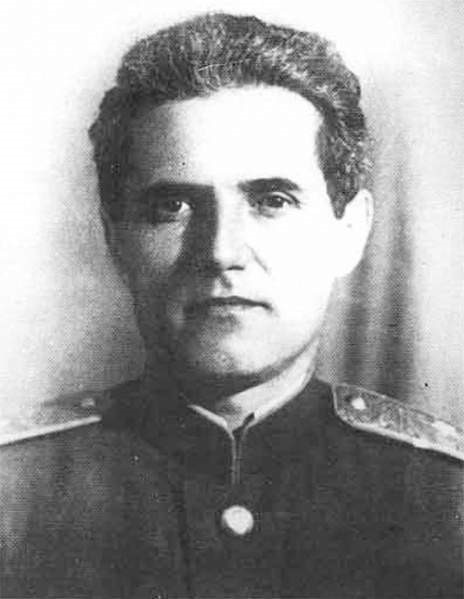
Victor Fiodorovich Bolkhovitinov (Russian: Виктор Фёдорович Болховитинов) was born on January 23 (February 4 according to the new calendar), 1899 in the city of Saratov, in the Soviet Union.
In Saratov Boljovitinov finished elementary studies with a gold medal and entered the medical school of the University of Saratov, but after a semester he understood that medicine was not his profession and requested a transfer to the physical-mathematical faculty. In 1918 he moved to Moscow, joining the MVTU.
In this institution, he listened to various lectures given by Nikolai Egórovich Zhukovski and fell in love with aviation. In 1921 he entered the Institute of Engineers of the Red Air Fleet, which would later become the Zhukovski Military Aeronautical Academy.
As a student, In 1924 he created the AVF-6 Favzayat and AVF-18 Pioner gliders, which participated in the national competitions at Koebel. Later he was part of a group of enthusiasts who designed a small plane.
In 1926 he finished his studies at the Zhukovski Air Fleet Academy and began working as an aviation mechanic at the Sevastopol Military Aviation School. Sometime later, he returned to the Academy, beginning his work as a teacher. From 1931 he was in charge of the projection work of the KB VVIA. From 1933 he directed the OKO de la Fábica No.22 and in 1937 he was appointed head of the Department of Aeronautical Construction.
Between 1934 and 1936 Bolkhovitinov led the work on the long-range heavy bomber DB-A, created as a development of the Tupolev TB-3 and in which between 1936 and 1937 Soviet pilots set 4 world records. The DB-A was produced in small series until 1940, being used as a transport.
Starting in 1936, Bolkhovitinov’s KB-22 was transferred to Kazan. In 1937 he was appointed main builder and entry into the ranks of the Communist Party of the USSR.
In 1939 he was appointed chief of the OKB-293, located in the factory of the same name in Khimki. In that year Bolkhovitinov directed the construction of the original “S” high-speed bomber with two counter-rotating propellers, which reached a speed of 570 km / h during testing. At the beginning of the 1940s, a ramjet took part in the installation tests on this aircraft, but development was abandoned at the beginning of the war.
Between 1941 and 1945 under his direction, engineers A. Ya Bereznyak and A. M Isayev developed the BI reactive engine interceptor fighter. In October 1941 the KB was evacuated to the outskirts of Sverdlovsk.
In 1944 AG Kostikov, head of the NII-3 reactive engine research institute, was arrested and Bolkhovitinov’s OKB-293 was unified with NII-1, a new reactive research institute.
Bolkhovitinov was appointed chief of investigations at NII-1 . In 1946 his OKB became part of the group led by M. Bisnovat, at Factory 293. As head of NII-1, Mstislav Keldish was appointed.
From 1947 Bolkhovitinov returned to work as a professor and chair at the Zhukovsky Military Aeronautical Academy, where he remained until his retirement.
Author of several books and publications related to aeronautical science.
He died on January 29, 1970 in Moscow and is buried in the Vvedienski cemetery.
Awards:
Twice Order of Lenin
Twice Order of the Red Banner
Order of the Red Banner of Labor Medals
 All Aero