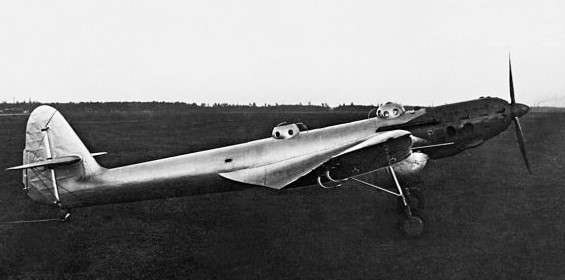
By the 1930s the euphoria of record flights had reached pilots and political leaders alike in the world’s most developed countries. In 1937, after making their flights across the pole, Valeri Pavlovich Chkalov’s crew sent a letter to Stalin where they wrote:
“We understand your claims to allow us to fly outside the borders of the USSR in 1939. There is not so much time left for 1939, for this reason we are writing to you with the request to build an airplane with a range of 15 – 20 thousand kilometers with diesel engines and capable of flying at 8 – 10 thousand meters … “
In response in October 1938 a resolution was issued by the Commissioner of the aviation industry MM Kaganovich, establishing development in the BOK led by Chizhevski of the long – range aircraft, the BOK-15.
The BOK-15 aircraft design began in Smolensk and the BOK-7 was taken as the basis for development. The main directions of work were aimed at improving aerodynamics and increasing fuel capacity. Initially, the works were carried out slowly and only on July 9, 1938 did the commission to analyze the model meet, made up of the pilots Gromov, Yumashiev, Danilin and Petrov.
The fuselage was of the monocoque type with the pressurized cabin forming an integral part of it.
The BOK-15 wing featured traditional double spar construction, similar to that used on earlier BOK stratospheric aircraft. This scheme led to the wing spars going through the pressurized cabin. Each wing spar consisted of two steel tubes joined by duralumin walls. The space between the spar and the wing leading edge housed 12 tanks capable of holding 7.5 tons of fuel. The wing coating on the BOK-15 was smooth, using 0.6 to 1.5 mm thick duralumin sheets.
The tail unit was practically the same one used in the BOK-7 and BOK-11.
The landing gear was similar to that of the ANT-25, semi-retractable in the fuselage. The exposed parts were covered with fairing. The oleo-pneumatic system was calculated for the landing with the maximum weight of flight. The tail wheel did not retract.
The selected powerplant was the Charomsky AN-1RTK capable of developing 1,100 hp, driving a three-bladed propeller.
The BOK-15, for the first time in the USSR, featured a sealed ventilated cabin. Although this new cabin, calculated for three people, presented a number of new technological challenges, it was lighter by 300 – 500 kg than the regenerative type cabin used in the BOK-1.
Access to the cabin was through two doors, one at the top, for emergencies and the other at the bottom of the plane. The crew consisted of three: two pilots and a navigator. The two pilots sat side by side and had dual flight control. On the left seat, intended for the captain of the aircraft, a transparent drop-shaped cover was installed. The other pilot had only side visibility. The navigator was located in the back of the cabin, where the radio station and equipment for route calculations were located. In order to avoid the use of thermostats for the motor oil, the oil tanks were located inside the sealed cabin. On one of these tanks, on the right side of the cabin, there was a bed for the rest of the crew.
Due to the transfer of the BOK to KB-29 in 1939, the development of record-setting aircraft was slow. The decision to build two BOK-15 was finally made by the NKAP on 10 February 1939. However, construction had started some time before at the facilities of Factory No. 35 in Smolensk, after some discussions between Chizhevski and the NKAP commissioner Kaganovcih.
The first of the two were 10-12% ready by January 1, 1939. The tail unit, flight control mechanisms, power bank and landing gear were built on the KB-29 at Podlipki. The most technologically complex aggregates were ordered from Factory No.156.
The requirements for the new wing structure grew as the project continued to develop. Initially, keeping dimensions similar to those of the BOK-7 wing, emphasis was placed on strengthening the wing structure only in the area where the fuel tanks were located. After a few months, the TsAGI was tasked with selecting a more effective wing profile for the BOK-15. The factory was forced to develop a smooth, polished coated wing with a better finish quality.
Several very long-range flights were planned to be carried out with these two aircraft. According to initial calculations, the BOK-15 was to reach a distance of 24,000 kilometers without stops. This would make it possible to go around the world without stops and thus surpass the results of the North American pilots William Post and Howard Hughes. Even more spectacular flights were planned, such as the one around the world flying over the poles.
The calculated cruising speed was 240 km / h (about 70 km / h more than the ANT-25). To achieve these results it was necessary to use a diesel engine. The only candidate with these features was the AN-1RTK engine, developed in 1931. By 1935 the AN-1 had passed state tests in which at an altitude of 3000 meters it had been possible to set a nominal power of 850 hp with a fuel consumption of 170 – 180 liters per flight hour. A series production of 20 of these engines had been ordered at Factory No.24 in Moscow. The AN-1RTK version was turbocharged and weighing 1100 kg, developing a maximum power of 1250 hp (for about 5 minutes) and a rated power of 1000 hp at 5500 meters. Only this engine was capable of working in the air between 50 and 100 hours to reach the requested 18 – 24 km. The calculations showed a consumption of only 0.43 kg of fuel per kilometer of flight at the cruising speed of the BOK-15.
The data were only theoretical and were not proven. In practice the BOK-15 turbochargers were constantly failing. The oil losses were so great that the pilots were forced to carry a large additional tank with oil on board. All this had a negative influence on the engine’s consumption. It was necessary to make changes to the projected flight routes, since the aircraft’s range guarantee did not exceed 15,000 kilometers. Manufacturers even proposed to replace diesel engines with the carburetted AM-35TK designed by Alexander Alexandrovich Mikulin.
Preparation for flights began in 1939, long before the appearance of airplanes on the airfield. According to the order issued by No.0018 VVS on 21 January 1939 for the realization of long – haul flights were prepared two crews with the following composition:
- Brigade Commander Gromov, Colonel Yumashiev, Brigade Commander Danilin
- Colonel Baidukov, Brigade Commander Spirin and Brigade Commander Beliakov.
All of these pilots, with the exception of navigators Spirin and Danilin, were released from their duty responsibilities and began preparation for the flight. This group of pilots received on January 25 DB-3, SB and R-5 aircraft for training, being located at the central airfield.
Preparation of the BOK-15s for flight was slow. The fault of the engine again, but the commissioner of the aeronautical industry MM Kaganovich, instead of giving his support to the KB-29 began to look for a culprit. The “enemy of the people” this time was VA Chizhevski.
In a letter Kaganovich wrote to Stalin of 28 January of 1938 he wrote:
“ The state of the construction and work apparatus of Chizhevski’s KB-29 is such that it does not allow to trust in the accomplishment of the great task that has been assigned to them in the construction of the BOK-15 plane … to be able to build this plane without Chizhevski it is necessary to assign this work to a large group of qualified builders and move their production to a more qualified factory … In the coming months it will be necessary to strengthen and clean the group of harmful people … With Chizhevski, act without delay ”.
Four days later, a commission report reviewing the BOK-15 technical documentation found an error in the number of the overload coefficient. In the opinion of the commission, the coefficient should be calculated not at 3, but at 3.5 to avoid the destruction of the aircraft in the event of extreme overloads. The argument that the ANT-25, capable of performing two flights across the North Pole to the United States, was also calculated using a coefficient of 3. On February 1, 1939 VA Chizhevski was arrested.
As of January 24, the TsIAM began the revision of the AN-1RTK engines for the BOK-15, receiving the task of delivering two units with BISh-34D propellers to the KB-29, but without a compressor, by March 15.
The first BOK-15 with AN-1RTK engine and 4.75 m propeller was completed on October 9, 1939. The first flight took place on October 17. Even before completing the tests, it was decided to install better quality wings on both aircraft that should allow for a greater range. This decision brought about great changes and for this reason as of 1 June 1940 the first example was only 80% ready and the second 50%. In Europe the war had already started so the decision to make the flight was rejected. The Soviet leadership decided to abandon all developments of the stratospheric BOK.
However, the development of the BOK-15 continued. Originally it was decided to change the engine to a turbocharged M-40F diesel engine TK-E88, which had completed 100 hours of testing in September 1940. Despite the fact that the engine showed lack of completion, it was decided to install this engine and start the flight tests. The M-40F developed 1500 hp at takeoff with a rated power of 1200 hp and had a weight of 1200 kg. As fuel it used kerosene.
Another engine that successfully passed the tests was the M-30 diesel, which was a version of the M-40. The main difference was the installation of a turbocharger on each side of the engine. In relation to weight and power, both engines were similar. The manufacturer Tulipov promised to have the M-30F ready with a maximum power of 1700 hp in the near future. This proposal led to the decision to prepare the second BOK-15 to install the M-30 engine. The beginning of the war did not allow these changes to be made. In 1941 the second of the BOK-15 was evacuated to Kazan.
In the summer of 1940 the first BOK-15 flown by Gromov was based at Department 8 TsAGI airfield in Ramenskoye, along with other stratospheric BOKs. On this date the plane was used for the filming of the movie “Valeri Chkalov”, painted with the colors and serials of the ANT-25. The remains of this aircraft were long in the Ramenskoye aircraft graveyard. At the end of the war the fuselage was still preserved there with the name “Stalinsky Marshrut” (Stalinian Route) painted on the side.

BOK-15
Powerplant: 1 Charomsky AN-1RTK 1200 hp diesel
Wingspan: 32.0 m
Wing area: 81.4 m²
Length: 15.75 m
Height: 5.77 m
Empty weight: 4679 kg
Fuel weight: 7500 kg
Maximum takeoff weight: 13.57 kg
Wing loading: 166 kg / m²
Maximum speed: 333 km / h
Cruising speed: 266 km / h
Maximum speed at 8000 m: 328 km / h
7500 kg weight ceiling: 11300 m
Range at 256 km / h: 13,500 – 15,000 km
Accommodation: 3
 All Aero