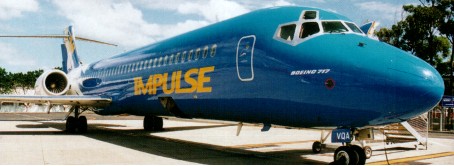
By the early 1990s, the three leading airframe manufacturers became aware of the demand for a smallerjet airliner. In particular, over the next two decades there is a market requirement for approximately 2,600 aircraft having a nominal seating capacity for 100 passengers.
To meet these requirements Boeing announced its new generation 737 600; Airbus the A319 and McDonnell Douglas the MD 95, all smaller derivatives of highly successful medium haul airliners. The B737 600 was given the build go ahead in March 1995, with entry into service scheduled for mid 1998 and the MD 95 was shown the green light six months later in October 1995. At that stage the A319 was ahead of the field, the lead aircraft configured in 116 seat layout being readied for delivery to Swissair in April 1996.
Launched in October 1995, by the end of 1999, the first of a 100 MD-95 contract (50 firm, plus 50 options) to AirTran Airlines (formerly ValueJet) was signed. With the merger of Boeing and McDonnell Douglas, commercial pressure resulted in the B717. The B717 200 has changed little from the McDomell Douglas concept for the MD-95. Similar in size to the DC 9 30, with a wingspan of 28.45m (93ft 3.5in) and overall length of 37.8m (124ft 0in).
The BMW Rolls Royce BR715 turbofan engine was developed specifically for it. First flew on 2 September 1998 and certified on 1 September 1999.
The Boeing 717-200 received simultaneous joint certification from the US FAA and European JAA on 1 September 1999. Five teat aircraft flew over 2000 hrs in more than 1900 flights.
On September 23, 1999, the first production 717-200 (N717XD, to be re-registered N949AT) was handed over to launch customer AirTran Airways at Long Beach, California.
On 23 May 2006 the last ‘Douglas Commercial’ airliner, a Boeing 717, was handed over to Air Tran at Long Beach, California.
B717-100
Seats: 86.
B717-200
Engines: Two BMW Rolls Royce BR715 turbofans, 82.2kN (18,500 lb) take off thrust with options available up to 93.4kN (21,000 lb).
Total fuel capacity 13,892 litres (3,056 Imp gal).
Max cruising speed, 0.76 Mach; 438kts (811 km/h).
FAA take off field length, (MTOW, SL, Temp = 30 degC) 1,950m (6,400ft).
FAA landing field length, (MLW, SL) 1,445m (4,740ft),
Range (domestic reserves, 106 passengers and baggage), 2,867km (1,547nm
Weights: Space limited payload, 12,220kg (26,940 lb).
Design gross maximum ramp weight, 52,163kg (115,000 lb).
Maximum take off weight, 51,710kg (114,000 lb).
Maximum landing weight, 46,266kg (102,000 lb).
Maximum zero fuel weight, 43,545kg (96,000 lb).
Operator’s empty weight, 30,785kg (67,870 lb).
Wingspan, 28.45m (93ft 43/4in).
Wing area, 305 sq.m (1,000.7 sq.ft).
Length, 37.81 m (1 24ft 0in).
Height, 8.92m (29ft 1 in).
Cargo hold, 26.5 sq.m(935 sq.ft).
Accommodation: Two crew and up to a maximum of 106 passengers in typical two class configuration.
Total cargo volume: 26.33 cu.m (930 cu.ft).
 All Aero