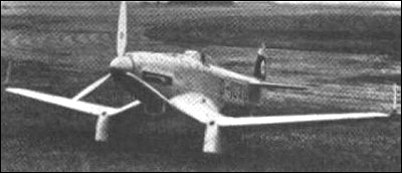
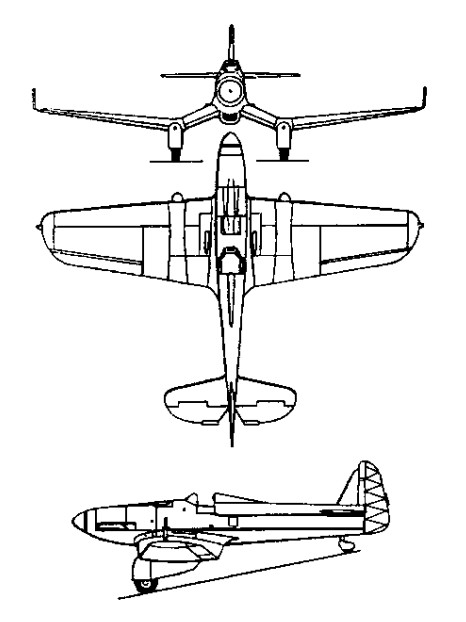
The Ha.137 was a close-support aircraft and dive bomber, an inverted gull-wing monoplane with fixed landing gear derived from the Ki-5.
First flown in April 1935, there were 6 aircraft built, the last of which, V6, was written off after crashing in July 1937. The first two models V1 and V2 (D-IXAX and D-IBGI) were powered by the Pratt and Whitney Hornet, licence produced as BMW 132 engines. The third prototype (D-IZIQ) produced used a Rolls Royce Kestrel.
It became apparent that the radial engine of the first two prototypes was not suited to the dive-bomber role because of the severely restricted forward view and the Jumo 210A engine was selected to be the definitive power plant. In 1936 three further prototypes were built: V4 (D-IFOE), V5 (D-IUXU), and the ill fated V6 (D-IDTE). These were to be Ha137B, the previous 3 being the Ha137A.
The Luftwaffe selected the Junkers Ju-87 and with the cancellation of the project no further work was taken.
A single-engined, single-seat, open cockpit dive bomber of entirely metal construction.
Ha.137A V1 & V2
Engine: BMW 132, 720 hp
Propeller: Metal three-bladed, variable pitch
Wingspan: 11,15 m
Length: 9,46 m
Height: 2,80 m
Wingarea: 23,50 sq.m
Empty weight: 1814 kg
MTOW: 2415 kg
Wingloading: 102,765 Kg/sq.m
Power loading: 3,354 Kg/hp
Max speed: 330 km/h
Cruise speed: 290 km/h
Ceiling: 7000 m
Range: 580 km
Armament: 2 x 7,92mm MG 17 mg, 2 x MG 17 or 2 x 20 mm MG FF, 4 x 50 kg bombs
Ha.137A V3
Engine: Rolls-Royce Kextrel IV 650 hp
Propeller: metal three-bladed variable pitch
Ha.137B V4, V5 & V6
Engine: Junkers Jumo 210A, 650 hp
Propeller: metal three-bladed variable pitch
 All Aero