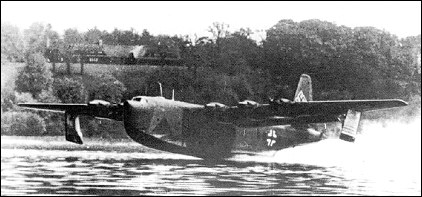
Originally designed as a passenger flying boat for the postwar Lufthansa, the BV 238 design was adapted in 1941 for military use as a maritime patrol and transport aircraft. When completed in 1944 it was the largest aircraft since the Maxim Gorkii and the heaviest built to that time.
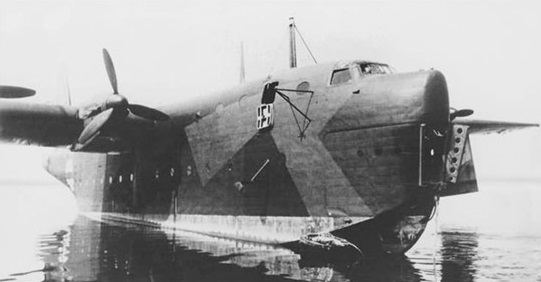
A quarter-scale testbed called the FGP 227 was deemed necessary to test the aerodynamics and water handling, but it completely failed to take off when tested on wheels and was then damaged by saboteurs. All the engines seized on the FGP 227 first flight from water — months after the first full-scale BV 238 flew in April of 1944, powered by six Daimler Benz inverted V-12 engines.
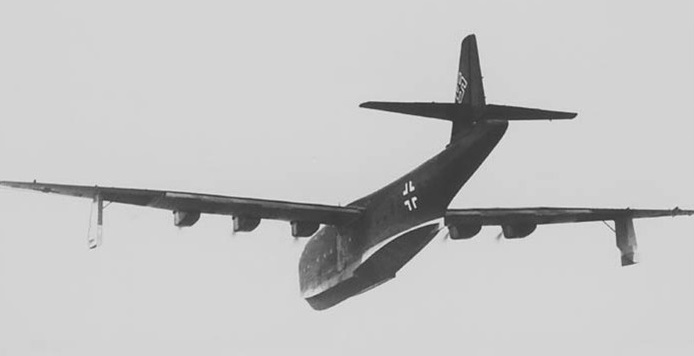
The sole complete BV 238 was caught on a lake by P-51 Mustangs and sunk by machine-gun fire in September 1944. Although three further BV 238s and three BV 250 landplane bombers were under construction, the loss of the only flying example caused the Luftwaffe to give up on the idea.
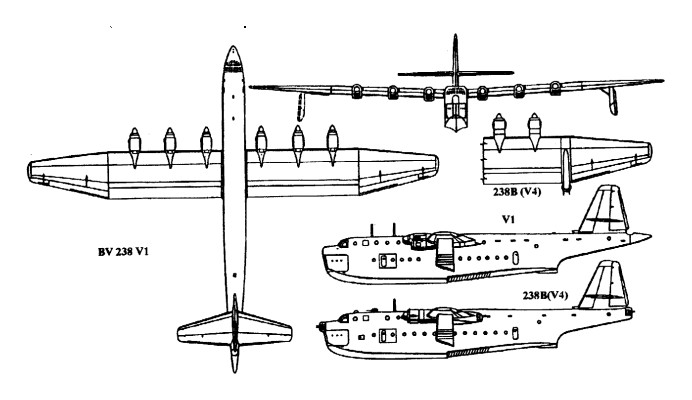
Bv 238 V-1
Engines: 6 x 1900hp Daimler-Benz DB 603G inline piston
Wingspan: 60.17 m / 197 ft 5 in
Length: 43.36 m / 142 ft 3 in
Height: 12.80 m / 41 ft 12 in
Empty Weight: 120,593lbs (54,700kg)
Maximum Take-Off Weight: 187,393lbs (85,000kg)
Max. speed: 425 km/h / 264 mph
Maximum Range: 4,474miles (7,200km)
Service Ceiling: 23,950ft (7,300m)
 All Aero