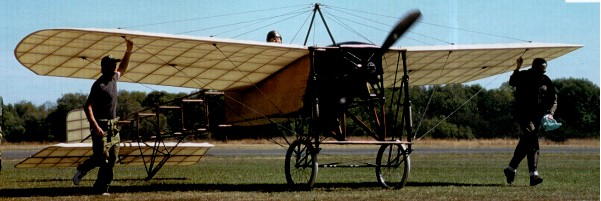
A Bleriot XI first flew on 23 January 1909 at Issy-les-Moulineux, France, powered by a 30 hp / 21.5kW REP engine driving a four-blade propeller. The fuselage was built of ash with supporting struts and wire ties. The shoulder-mounted wooden monoplane wing incorporated wing-warping for lateral control. Two large bicycle wheels made up the undercarriage, connected to a pair of steel tubes braced by wooden beams. The undercarriage was compliment by either a skid or a third wheel set just aft of amidships.

While the forward portion of the fuselage was covered over in cloth, the aft portion was completely exposed, showcasing the internal basic skeletal strut-and-cable arrangement and directly (though unintentionally) leading to improved lateral stability through added drag. The empennage was detailed by a single cloth-covered vertical tail plane acting as the rudder (though no vertical stabilizer was present) and a horizontal plane containing the stabilizer and elevator set alongside the bottom of the rear fuselage. The main wings were high-mounted on the cloth-covered portion of the fuselage body and featured a distinct airfoil – thicker at the leading edge and relatively thin at the trailing edge – utilizing “wing-warping” instead of ailerons to achieve roll. General construction was of oak and poplar with cloth covering.
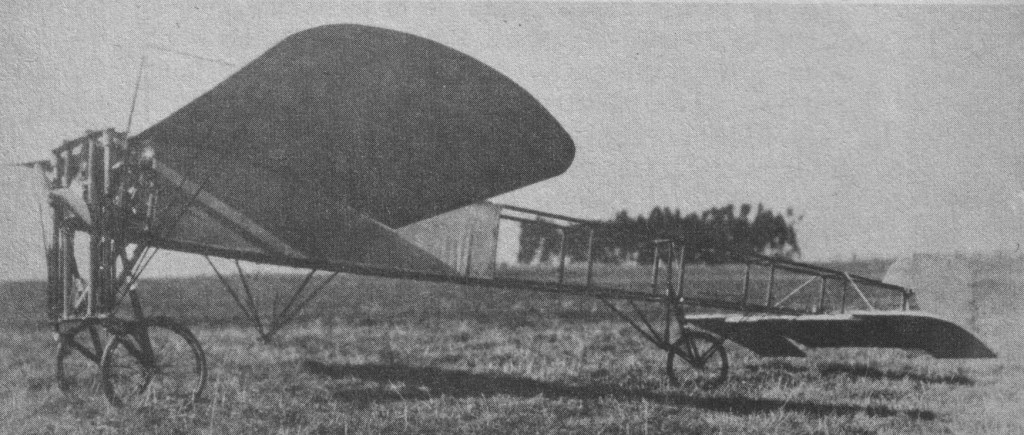
During April and May of 1909 the aircraft was refined and fitted with a 16.4-18.6kW Anzani 3 engine and Chauviere two-blade propeller. The central fin that had been fitted was removed and the rudder was enlarged and deepened, and the ‘elevons’ at the ends of the tailplane were arranged to function solely as elevators.
Flying the Bleriot XI – Frank Tallman
In October 1908 Bleriot won fame with a 25.5 mile cross-country flight, during which he landed three times.
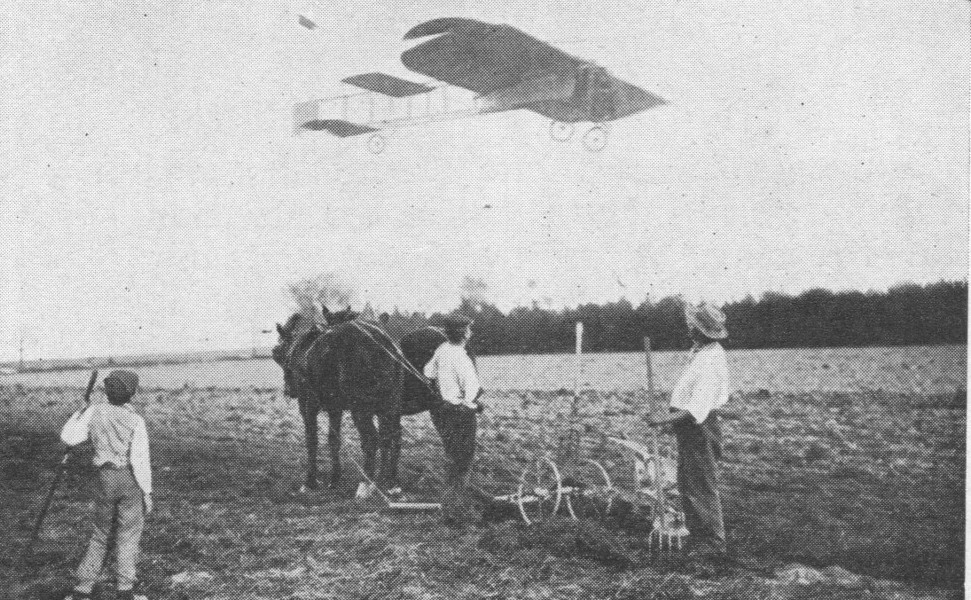
The Bleriot XI was the first aircraft to fly the English Channel, carrying Louis Bleriot between Calais and Dover on 25 July 1909. The actual aircraft used is preserved in the Paris Conservatoire des Arts et Metiers. The crossing gave the design considerable commercial impetus.
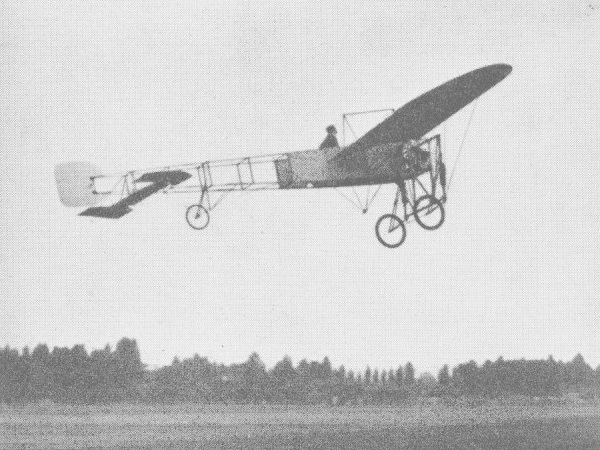
The flight was part of a 1,000 pound prize as put forth through a competition arranged by the London Daily Mail. Matching up against two other would-be winners, Louis Bleriot and his XI took to the skies on July 13th, 1909 and spanned some 36 minutes and 55 seconds, setting the new European endurance record with a distance of 36.6 kilometers from Les Barraques, France to Dover, England. One competitor, Hubert Latham was forced into the sea after developing engine troubles while a test flight for the third entrant, Charles de Lambert, ended in a crash with injuries sustained. Bleriot landed his XI and earn the 1,000 pound prize, though foul weather played a role in the rough landing that caused damage to the propeller and undercarriage. Nevertheless, Bleriot’s legacy was sealed as “The Man Who Crossed the Channel”.
Powered by a 25 hp Anzani, the single seat craft was capable of around 46 mph.
The aircraft was showcased at the December 1909 Exposition de la Locomotion Aerienne show in Paris.
In April 1911 Pierre Prier completed a London to Paris flight, in 1912 by Henri Salmet completing a London to Paris and return flight.
Bleriot XI London-Paris-London Article
In Pau, Grahame-Whites Blériot XII machine crashed with Blériot at the controls and Grahame-White as a passenger. After that, Blériot decided that the XII was not worthy of further development, and he gave Grahame-White two Blériot XI airplanes as compensation for his lost model XII.
The design was stretched to provide seating for two as the Xl-2 model, powered by a 70 hp Gnome rotary piston engine. The Vickers 22 was a licence built Bleriot XI-2.

The Blériot XI-2 Artillerie named “Ça Flotte” that the Norwegian explorer, flyer and writer Tryggve Gran flew across the North Sea from Crudden Bay Scotland to Stavanger, Norway on July 30 1914. Renamed “Nordsjøen”, it is now in a museum.

The fully covered fuselage and broad triangular tail planes are the main differences from the famous “La Manche” type. It appeared in January 1910 and was built for a short time only. It was shown in several magazines as the “new Blériot type” early that year. Controls consisted of warping wings instead of ailerons, a rudder and elevator. There was no fin. Anzani engines were probably used initially, while the Gnôme might have become common with the better known, and more frequently pictured, side-by-side two-seater XI-2 bis, which was entered in several competitions later that year.
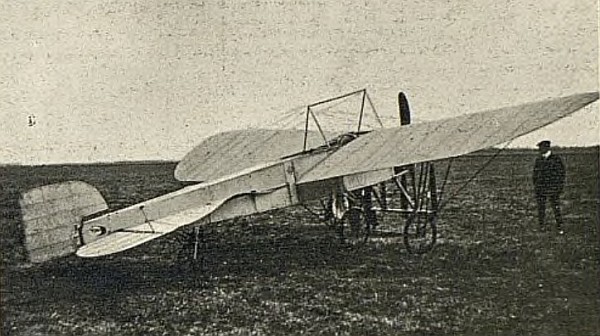
Military service for the Bleriot XI began sometime in 1910 when the aircraft was accepted into the ranks of the French and Italian air services.
Operated by the RFC, and about 25 served with the RNAS, all were retired by early 1915, although some were used later by the Italians when they entered the war.
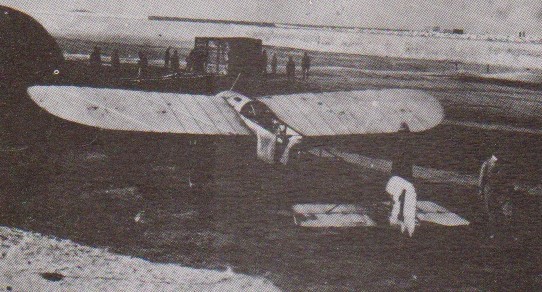
The Italian Army in Libya was among the first users. Major Morris had visited France in 1910 specially to buy two machines for the Italian Government which later ordered a further three.
One became the first aeroplane to be used in a war, when Capitano Piazza of Italy made a reconnaissance sortie over Turkish troops at Azizia on 22 October 1911. The first bombs to be dropped from an aeroplane were released from a Type XI on 1 November 1911. The British began operation of their Bleriot XIs in 1912. By the time of World War 1, the Bleriot still retained some military value and was thusly pressed into service in their two-seat forms serving primarily as observation and trainer aircraft. As technology naturally progressed during wartime, the need for Bleriots became less and less to the point that the system was fully relegated to the training role.


The Bleriot XI was built for many years, but in different types. During 1911 only the Type XI Tandem was produced.
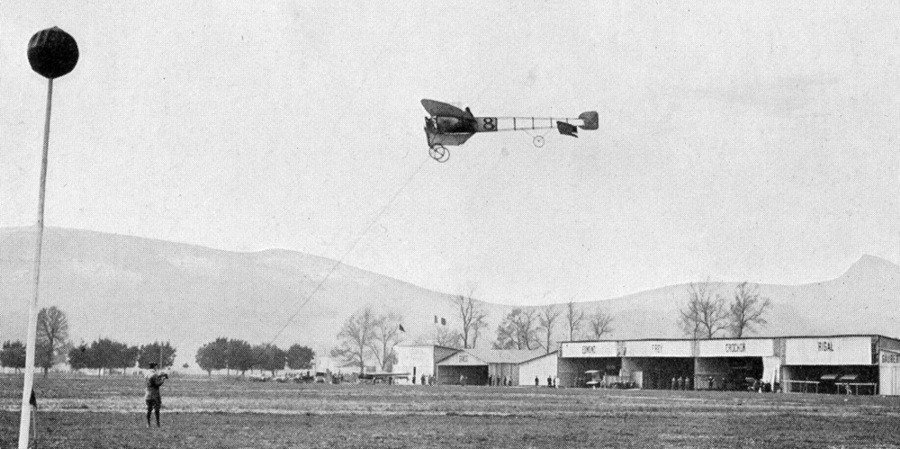
Léon Molon’s Blériot XI is recognizable, due to the inverted air keel fitted to the nether regions of the fuselage, installed perhaps to help with the craft’s performance during turns.
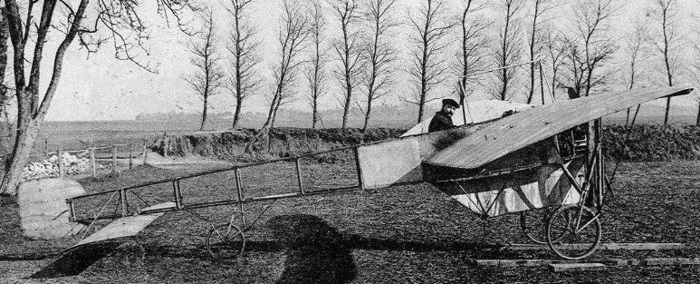
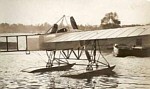
The single-seater versions and some which were fitted with floats, which were fitted with the smaller 60 hp Gnome were shorter in length and span. They achieved a higher speed of 68 mph.

Bianchi had in 1960 created a one-off Vickers 22 (Blériot type) Monoplane at White Waltham, using Vickers company drawings intended for the Vickers Flying Club in 1910, a JAP J-99 engine and wing warping. Serialled PPS/REP/1 and first flying in 1960, the completed prototype was available and 20th Century Fox purchased the replica for the 1964 “Those Magnificent Men in Their Flying Machines” film, though it required a new Continental A75 engine and modifications including replacing the wooden fuselage structure with welded steel tubing as well as incorporating ailerons instead of wing-warping. The Vickers 22 became the final type used by the Italian contestant. Sometime after the film, the Vickers was sold in New Zealand. It is believed to have flown once, at Wellington Airport in the hands of Keith Trillo, and is now at the SouthWard Museum.
Replica:
Fearnside Bleriot XI replica
Airdrome Airplanes Bleriot XI
Dart Aircraft Bleriot XI
Variants:
XI-Ecole Type (Trainer)
XI-Taxi-Pinguin
Span: 29’3″
Length: 25’7″
Weight: 915 lb
Speed: 60 mph
XI-Artillerie
XI-Type
Span: 29’3″
Length: 25’7″
Weight: 660 lb
Speed: 55 mph
XI
Engine: Anzani 25 hp
Span: 25’6″
Length: 26’3″
Weight: 661 lb
Speed: 45 mph
Type XI-bis
1910
Span: 29’6″
Length: 26’3″
Weight: 1375 lb
Type XI-2bis
Span: 36′
Length: 27’3″
Weight: 1930 lb
XI-2 Genie
Span: 31’10”
Length: 27’3″
Weight: 1200 lb
Speed: 68 mph
XI-2 Hauteur
XI-3 Concourse Militaire
3 seater
Span: 37’3″
Length: 26′
Weight: 1150 lb
Specifications:
Engine: REP, 30 hp
Engine: One 25 hp, 18kW Anzani.
Length: 26 ft 3 in
Wing span: 25 ft 6in / 7.8 m
Wing chord: 6 ft.
Wing area: 150 sq. ft.
Height: 2.5 m / 8 ft 2 in
Wing area: 14.0 sq.m / 150.69 sq ft
Weight empty: 460 lb / 210 kg
Take-off weight: 270 kg / 595 lb
Seats: 1
Cruise speed: 36 mph / 58 kmph
Max. speed: 70 km/h / 43 mph
Range 25+ miles / 40+ km
Engine: Gnome Omega rotary, 50 hp.
Prop: 2 blade
Wing span: 31 ft 9 in
Length: 27 ft 3 in
Empty weight: 705 lb
MTOW: 1388 lb
Max speed: 68 mph at SL
Cruise: 42 kts.
Fuel cap: 30 lt
Oil cap: 8 lt.
Endurance: 1.5 hr
Bombload: 50 lb
Bleriot XI
Engine: Gnome, 70 hp
Wingspan: 33 ft 11 in / 10.33 n
Length: 27 ft 10 in / 8.48 m
Height: 8 ft 5 in / 2.65 m
Weight: 1838 lb / 834 kg
Max speed: 66 mph / 106 kph
Ceiling: 3280 ft / 1000 m
Endurance: 5.30 hr
Crew: 2
XI-2
Engine: Gnome 7 cyl rotary, 80 hp.
Top speed: 66 mph
Seats: 2.
1911 Type XI Tandem
Span: 36′
Length: 27’3″


 All Aero