
The need to train pilots led Blackburn to develop a larger, two-seat monoplane, which he christened Mercury. The Mercury was the third aircraft built by Robert Blackburn at the factory in Leeds. Powered by a 50hp (37 kW) Isaacson radial engine, it was a two-seater and flew early in 1911 flying from the beach at Filey with the newly formed Blackburn Flying School. The new machine, sometimes known in retrospect as the Mercury I, joined the Second Monoplane at the Blackburn Flying School.
The Mercury I was displayed at the Olympia Aero Show in March 1911.
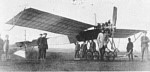
In May 1911, it flew from Filey to Scarborough and back in 19 minutes at an average speed of 50 mph, reaching an altitude of 1200 feet. This aircraft crashed the next day when the engine seized and the propeller flew off.

Interest had been aroused in the Mercury and orders were received for eight aircraft. The first two, known under the designation Mercury II, were single-seaters, each with a 50-hp (37-kW) Gnome rotary and were built for the Daily Mail Circuit of Britain contest, which offered £10,000 in prize money. The first machine was lost in a take-off accident, while the second, being converted to a two-seater, and later being revised as a school machine with wings of greater span and receiving the designation of Type B. Of the remaining six Mercurys, the first (Mercury Passenger Type or Mercury III) had a 60-hp (45-kW) Renault engine, the second a 50-hp (37-kW) Isaacson engine, the third, fourth and fifth machines were powered by the 50-hp (37-kW) Gnome rotary, and the sixth had an Anzani engine of similar power.
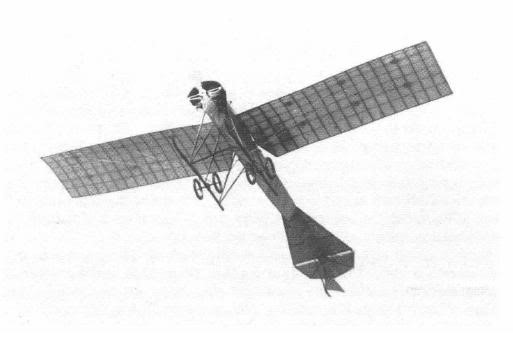
Reported in November 1911, Hurbert Oxley had the new Blackburn passenger machine out. This is fitted with a Renault motor and had just been completed. He made one or two straight flights, taking the pupils as passengers, at its first appearance. Next day he was again out trying the same machine. Several short flights were made with passengers. The estimated speed of this machine is 65 mph when fully loaded.
The Renault engined Mercury crashed at Filey in December 1911, killing an instructor and passenger.

Other Blackburn Monoplanes were built for private owners and examples were shown at the Olympia Aero Shows in 1911 and 1914, and also took part in the Daily Mail sponsored Circuit of Britain Race in 1911.

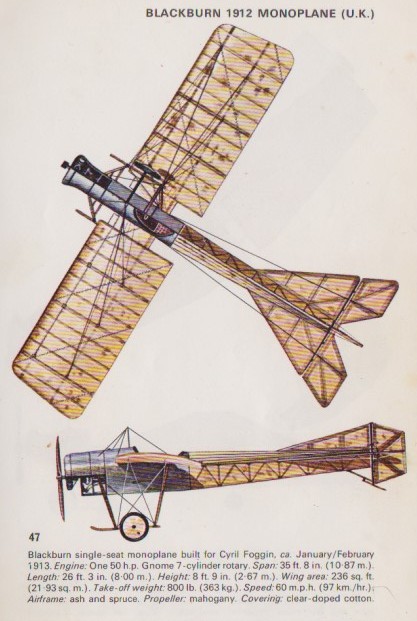
Constructor number 725 was built in 1912 for Cyril Foggin. Stored at Wittering by Francis Glew until 1938 it was again stored during WW2 In 1947 it was restored to flying condition.

Mercury I
Engine: 1 x 50 hp Isaacson
Wing span: 38 ft 4 in
Length: 33 ft
Gross weight: 1000 lbs
Max speed: 60 mph
Number built: 1
Mercury II
Engine: 1 x 50 hp gnome
Wing span: 32 ft
Length: 25 ft
Gross weight: 750 lbs
Max speed: 80-85 mph
Number built: 1
Mercury III
Engine: 1 x 60 hp Renault
Wing span: 38 ft 4 in
Length: 33 ft
Gross weight: 800 lbs
Max speed: 85-90 mph
Number built: 9
c/n 725
Engine: Gnome, 50 hp
Wingspan: 32 ft 1 in
Length: 26 ft 3 in
All up weight: 900 lb
Max speed: 60 mph
 All Aero