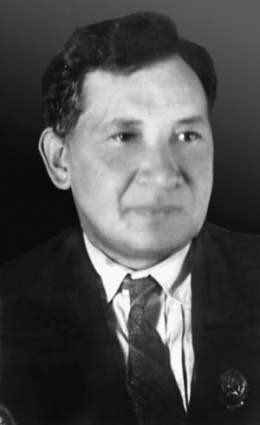
Victor Belyayev was born on March 28, 1886. Between 1920 and 1923 he studied at the Moscow Polytechnic Institute and the MGU. In 1920 he took his first steps in aeronautical construction by building a biplane glider following the NB Delone scheme, but with wheel landing gear.
He began his professional career in aviation in Leningrad in 1925, when he joined to work as an engineer at OMOS led by DP Grigorovich, specializing in issues related to the calculation of aircraft resistance.
In 1926, at the age of 30, he moved to TsAGI, led by AN Tupolev. In this institution he worked on the resistance calculations of the Túpolev ANT-6, ANT-7, ANT-9, ANT-14 and the gigantic ANT-20 planes.
Between 1926 and 1924 Belyayev developed the theory and methodology for the calculation of rectangular wings, which was widely used as a theoretical basis for the calculation of resistance in Soviet aeronautical development for models with straight wings or low sagging. When the Belyayev aeronautical construction resistance department was created in the TsAGI in 1931, he went on to direct a research group, a task that he knew how to combine with his aeronautical projection and construction activity.
Over the years, before aeronautical engineers, he presented the task of overcoming the dangerous effect called “Flutter” as a way to achieve the necessary increases in flight speeds. Belyayev studied the phenomenon and provided fundamental contributions to combat it. For the first time he proposed to use anti-flutter weights as a measure to increase the stability of flight surfaces.
At TsAGI, engineers VN Belyayev and VI Yujarin developed a new wing design capable of moving the center to face this phenomenon without losing the necessary structural strength. The plan view of this configuration resembled an expanded letter M with a slim profile and large wingspan.
The need to confirm the effectiveness of this wing solution led Belyayev back into the field of aircraft construction. In 1934 he designed the BP-2 glider (Besxbosti Planer – Paneador sin tail), also known as TsAGI-2, demonstrating a high level of originality by applying the scheme without tail and its wings with inverted wing tufting. The model was tested towed by a forklift in the TsAGI hydro- channel. The BP-2 participated with great success in the IX National Competitions, held in Koktebel in 1934, showing excellent results. At the end of the competitions he was airlifted to Moscow, towed by aPolikarpov R-5.
With its second design, the glider recordista BP-3 of 1935, Victor Belyayev reaffirm its success. This glider first flew on June 18, 1935 and was characterized by its excellent flight characteristics. It has been claimed that several specimens were built in the workshops of the Yeisk Naval Pilot School. Both gliders demonstrated the accuracy of Belyayev’s calculations and the effectiveness of his original scheme.
In 1935 and in response to a competition launched by the All-Russian Scientific and Technical-Engineering Society of Aviation (AviaVNITO) and the newspaper “Tras el volar” developed a project for a twin-engine transport plane known as AviaVNITO-3, which was characterized also for the originality in the technical solutions. This project won second place in the competition and was proposed for serial construction, but was ultimately not built.
In the late 1930s, Belyayev went on to lead an aeronautical design structure known as OKB-16, located at the No.156 Experimental Building Factory in Moscow. In this factory were established several OKB aircraft building, including those of SA Kochierigin, VV Shevchenko and the famous TsKB-29 of the NKVD.
Among the members of this group were PN Obrubov, LL Selyakov, EI Korzhenievski, DA Zatvan, BS Biekin and NY Leontiev. Most of the works of this group were characterized by the novelty of their designs, apart from traditional schemes.
In 1938, on their own initiative, Belyayev and his collective began the development of a bomber version based on the AviaVNITO-3. Known as DB-LK, this version was tested in 1940 showing better performance than the DB-3M bomber, which was already being built. serially. In this same period, the experimental UK aircraft with an elastic butterfly wing with a Renault engine of 430 hp, which was built at the KAI in 1941, and the EOI experimental fighter with an original double fuselage scheme were projected in this same period. This fighter began to be built in1940, but it was destroyed before the evacuation in October 1941, along with the plans and calculations.
With the start of the war bureau buildings Belyayev was dissolved and he was evacuated to Omsk, where he initially worked in the factory No.166 and later as head of the group of calculations in KB of VM Myasichev, the factory No .288. In 1944 Belyayev worked on calculations for the high-level reactive fighter Bartini R-114.
At the end of the war Victor Belyayev returned to TsAGI where he devoted himself to the study of resistance in aeronautical construction. For his contributions in the field of structural resistance and the theory of the “Flutter” in 1940 he was awarded the category of doctor of technical sciences and in 1949 he received the category of professor.
He died on 25 of July of 1953 at 68 years old.
 All Aero