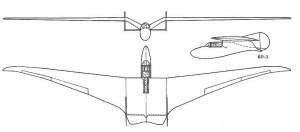
The Belyayev BP-3 (Russian: Беляев БП-3) glider of 1936 was developed by Victor Belyayev with forward-swept wing as a continuation of the BP-2 but in tandem configuration.
Success with the BP-2 led Belyayev to conceive of an improved model with larger dimensions and some changes. This two-seater capacity model appeared in 1935 as the BP-3 and had the wingspan increased to 20 meters.
The wing shape in the plane was generally similar to that of the previous BP-2, but in this case the wingspan had been significantly increased. Unlike the BP-2, the BP3 used a medium deployment wing with a gull-like curvature. This allowed to reduce the surface of the rudders and a more compact location of these. The hanging flaps located under the center plane disappeared.
The tail unit also received changes. Maintaining the double empennage structure, the horizontal plane on these was eliminated.
The BP-3 glider was designed as a two-seater and its crews were located in a closed cockpit.
The BP-3 was built in the TsAGI workshops and was flown for the first time on July 18, 1935. From the first flight, this aircraft presented excellent characteristics, with an aerodynamic quality that reached 33:1 glide, so it was decided to use it to establish a new record for gliding range.
The prototype was possibly followed by several copies built in the workshops of the Yeisk Naval Pilot School.
BP-3
Wingspan: 20 m
Length: 5.6 m
Height: 2.2 m
Wing area: 3.54 m²
Empty weight: 400 kg
Glide ratio: 33: 1
Seats: 2
 All Aero