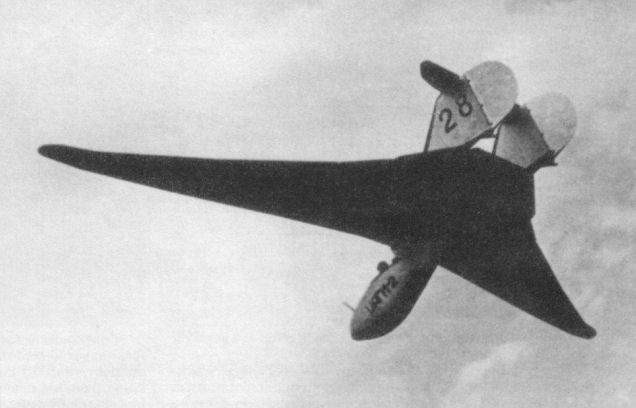
The Belyayev BP-2 (TsAGI-2) (Russian: БеляевБП-2 (ЦАГИ-2)), was an inverted arrow wing glider developed by Víctor Belyayev to test the effectiveness of this wing composition. Only one copy was produced.
In August 1933 Belyayev participated as a member of the TsAGI technical commission in the IX National Sailing Competitions held in Koktebel, Crimea. The main task of the commission was to check the technical condition of the gliders presented and to grant the authorization to fly. The commission considered that the best exponents were four glider models in a tailless configuration: the BICh-11, BICh-12 and BICh-13 from BI Cheranovski and the LAK-1 glider from a Leningrad flying club.
The presence at the Koktebel competitions prompted Belyayev to implement a conception idea for an airplane. The presence at the TsAGI of AA Sienkov, one of the pioneers of glider construction in the USSR, also played an important role in his decision.
In the TsAGI workshops during the winter of 1933 – 1934, these two specialists began on two new gliders: the BP-1 (TsAGI-1) from Sienkov and the BP-2 (TsAGI-2) from Belyayev. The name BP comes from the term B esxbosti P laner or paneer without glue.
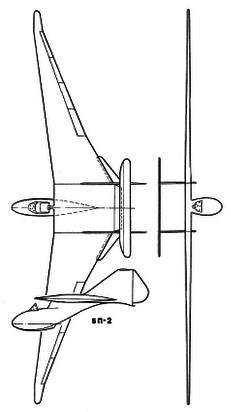
The BP-2 glider was conceived as a flying wing without horizontal tail planes, but with the presence of double keels with rudders.
The wing design was characterized by its large wingspan. The centroplane, designed with an M-6 profile, had a rectangular shape in the plane and the wing consoles with the G-387 profile were fixed to it. The wing, with an area of 18.5 m², presented a configuration with inverted sagging and noticeable stretching towards the ends; standing high above the fuselage. In conjunction with the wing configuration, the entire structure of the glider was conceived seeking the lowest weight and the best possible aerodynamics. The structure incorporated a single spar built in the shape of a box and located at 30% of the wing chord. Four-section ailerons were located on the wing’s trailing edge, designed to ensure the balance of the aircraft and its control. These ailerons covered 9% of the wing surface.
Hanging flaps were located on the trailing edge of the centerplane, designed with the aim of achieving glider balance in flight and improving longitudinal control. In addition to these flaps, two lateral flaps with a smaller area were located at the trailing edge and designed to modify the curvature of the wing profile at the base of the consoles.
The entire wing structure was built in wood and practically in its entirety was covered with plywood (only a small section in the central region of the wing was covered with fabric.
The landing gear consisted of a ski at the bottom of the nacelle and skids under the empennage.
The cockpit was located in the forward part of the centroplane, in front of the wing leading edge, ensuring the necessary centering. This gave the pilot excellent visibility, but in conjunction with the wing configuration impaired the longitudinal stability of the model. To correct this problem on both sides of the central wing area, two large area vertical surfaces topped by a small stabilizer with a large elevator were placed. Large rudders were located in the rear of both keels.
During the design process, an important investigative work was carried out in order to achieve the best wing shape. The configuration of the BP-2 was initially quite criticized in the TsAGI. Several specialists expressed doubts about the flight capabilities of the concept. It was decided to test the model in the wind tunnel. In the TsAGI there was also a 200-meter-long hydrochannel that had an electrically operated trolley for towing the models, which ran the entire length of it. It was decided to use this truck to tow the glider models, thereby quickly and effectively demonstrating that Belyayev’s design it was able to take off and stay in the air without difficulty.
Once finished, first flying in August 1934, the BP-2 was sent to Koktebel to participate in the X National Sailing Competitions, being flown by the pilot DA Koshits. The model demonstrated excellent flight stability and superb control. Pilot Koshits performed Nesterov’s “dead” loop on this glider.
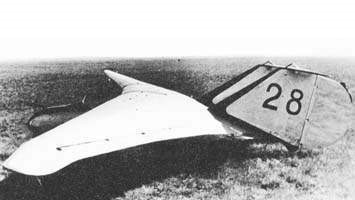
Pilots who had a chance to test it declared that the BP-2 had good flight characteristics and the ailerons were quite effective. It spun quite well. Landing speed was only 40 – 45 km / h. The only defect noted was the poor effectiveness of the rudders, which had to be complemented by the ailerons in flight to achieve the desired effect.
Despite its excellent design the BP-2 was only able to show a glide ratio close to 18 – 1. The main culprits for this limitation were the elevator located on the empennages and the flaps hanging under the centroplane.
After the tests the BP-2 returned to Moscow flying behind a Polikarpov R-5 towplane.
The experience gained with the BP-2 glider served as the basis for the development of the improved BP-3 and the DB-LK bomber.
BP-2
Wingspan: 14.8 m
Wing area: 18.4 m²
Aspect ratio: 11.9
Length: 5.08 m
Height: 2.40 m
Empty weight: 199 kg
Wing loading: 16.5 kg / m²
Minimum descent speed: 1.35 m / s
Stabilizers surface: 0.64 m²
Depth hole area: 1.42 m²
Keel surface: 2.76 m²
Rudder surface area: 1.08 m²
Spoiler area: 1.7 m²
 All Aero