
Two X-2s were built by Bell Aircraft at their Niagara Falls, New York, facility. The airframes were composed primarily of stainless steel and “K-Monel,” an advanced lightweight heat-resistant stainless steel alloy swept wings.
The powerplant comprised a 15,500 lb (6804 kg) thrust throttable Curtiss-Wright XLR-25-CW-1 liquid propellant rocket.
The jettisonable cockpit can be separated from the fuselage in an emergency by an explosive charge, a ribbon-type parachute lowering the complete cockpit to a lower altitude at which the pilot can bale put.
The first X-2 was dropped into Lake Ontario on 12 May 1953 following an explosion and fire that also caused extensive damage to the EB-50A launch aircraft.
A leather gasket made by the Ulmer Company, when saturates with liquid oxygen, was so unstable that a shock of and magnitude caused the gasket to blow. A number of accidents occurred involving the X-1-3, X-1A, X-1D, and X-2, before the malfunctioning gasket was identified and a fix made.

The second aeroplane made the type’s first powered flight on 18 Novernber 1955, and recorded an altitude of 126,000 ft (38,465 m) as well as a speed of Mach 3.2 (2,094 mph; 3,370 km/h), the latter being recorded during the type’s fatal last flight on 27 Septernber 1956. This remained the highest speed at which man had flown until 1961. The aircraft experienced “inertia coupling” resulting in complete loss of control—pilot Milburn Apt was killed in the accident. No examples of the X-2 survive.
Dick Day warned his air force associates not to push ahead so fast with the X-2, piloted by Ivan Kinchloe, Frank ‘Pete’ Everest, and Milburn G. Apt. Data from their work was confirming evidence from NACA wind tunnel tests that the X-2 would experience ‘rapidly deteriorating directional and lateral (roll) stability near Mach 4’. On 25 April 1956, the X-2 broke the sound barrier for the first time. Less than a month later, it flew past Mach 2. By mid-summer it was pushing Mach 3. When Mel Apt took the X-2 up on 27 September 1956, for his very first flight in the aircraft, his flight plan called for ‘the optimum maximum energy flight path,’ one that would rocket him past Mach 3 – and into roll coupling. The fatal crash happened just as Dick Day thought it might. At 65,000ft and a speed of Mach 3.2, Apt lost control of the X-2 due to roll coupling and became unconscious. By the time he came to it was too late. He died instantly when the plane hit the desert floor.
The two X-2s achieved 20 flights in total between 1952 and 1956.
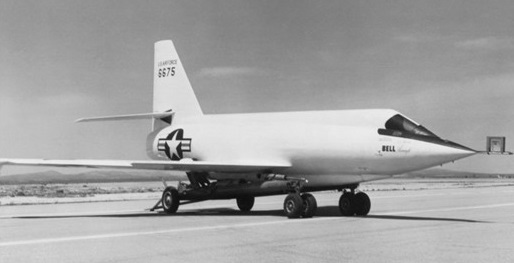
Engine: 1 x Curtiss-Wright XLR25-CW-1 rocket engine, 6804kg
Wingspan: 9.75 m / 31 ft 12 in
Length: 13.41 m / 43 ft 12 in
Height: 4.11 m / 13 ft 6 in
Max. speed: M3.2 (2,094 mph; 3,370 km/h).
Ceiling: 38405 m / 126,000 ft / 38,465 m
Crew: 1

 All Aero