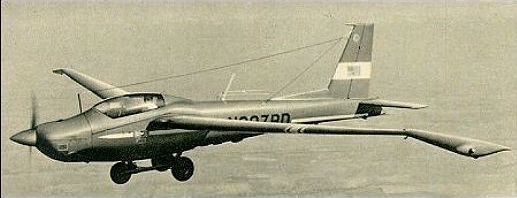
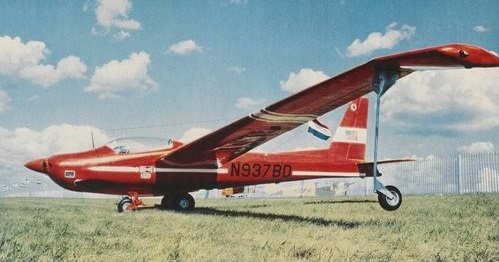
The BD-2 was a specially built airplane to demonstrate and establish world distance records. It was developed by modifying a Schweizer 2-32. The wings were completely sealed to hold a large quantity of fuel. The wing tips were developed and two main fuselage tanks permitted a total fuel capacity of 565 gallons. The fuselage was designed to house a 210 hp Continental IO 360 engine.
Through the plane’s development, Jim Bede learned that if the BD-2 had enough range to fly around the world, the aircraft would only be required to carry 2.5 pounds of fuel for every pound of dry weight.
The BD-2 wingtips were an innovative idea of an extended, reverse tapered wingtip. Designed in both function and shape, the wingtips allowed the BD-2 to improved everything from the efficiency of its flight characteristics, range of the aircraft, and overall wing strength.
The BD-2 used a tricycle landing gear assembly that could be dropped once the aircraft was sufficiently airborne in order to reduce weight, and would land using a wooden skin fixed under the cockpit, and the engine shut off and propeller feathered. The aircraft included a 25 lt liquid oxygen container that provided 5 days-worth of breathable oxygen, radios, and a Bendix autopilot system. Jim Bede made the first and all flights of the BD-2 including two long-distance test flights.
The first flight lasted 31 hours and went from Wichita, Kansas to Baltimore, Maryland to Jacksonville, Florida to Miami, then across the Gulf of Mexico to Corpus Christi, Texas, and finally back to Wichita. The second test flight, which lasted 33 hours, started in Cleveland, Ohio and went to Wichita, Kansas, then off to Minneapolis, Minnesota to Green Bay, Wisconsin; across Lake Michigan to Toledo, Ohio; to both Buffalo and Elmira, New York and finally, returned to Cleveland, Ohio during the Labor Day air show at Cleveland’s Burke Lakefront Airport. On November 7, 1969, Bede took off from Port Columbus Airport in Ohio in an attempt to set a new closed course record, which is measured based on the total distance of completed laps. He departed at 8:58am Friday to fly to Kansas City, Missouri and back. After completing nine complete laps, at 3am Monday morning the BD-2 lost all electrical power, but was able to make one last radio message to Indianapolis Control Center. He was able to alert operations at Columbus Airport and his flight surgeon Dr. Charles Billings. Three others rendezvoused mid-air with Jim and guided him safely back to the Toledo Airport. At 7:01am Monday morning, he landed, his total time in the air at a total of 70 hours and 15 minutes. The BD-2, with its incredible means of flight, set three world records. First, was the longest solo flight. Second, a new closed course record for any category of propeller driven aircraft of 8974 miles. It broke a B-29 record set in August of 1947 by Lieut. Col. Lassiter. Lastly, it broke the record for a closed course for that weight category. Bede took off with 451 gallons, which was the same amount of gallons the used by Lindberg on the flight to Paris, and completed it with a 121 gallons remaining.
Engine: 1 × Continental IO-360C, 210 hp
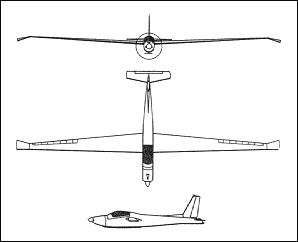
Wingspan: 63 ft 0 in (19.20 m)
Wing area: 192 sq ft (17.8 sq.m)
Aspect ratio: 20.7:1
Length: 27 ft 7 in (8.41 m)
Empty weight: 1,725 lb (782 kg)
Max takeoff weight: 5,600 lb (2,540 kg)
Cruise speed MTOW: 156 mph (136 kn; 251 km/h)
Cruise speed at 2,200 lb (998 kg): 108 mph (94 kn, 174 km/h)
Never exceed speed: 194 mph (169 kn; 312 km/h)
Stall speed: 62 mph (54 kn; 100 km/h) at 1,900 lb
Range: 20,500 mi (17,814 nmi; 32,992 km) estimated, still air
Endurance: 120 hr (estimated)
Crew: 1
 All Aero