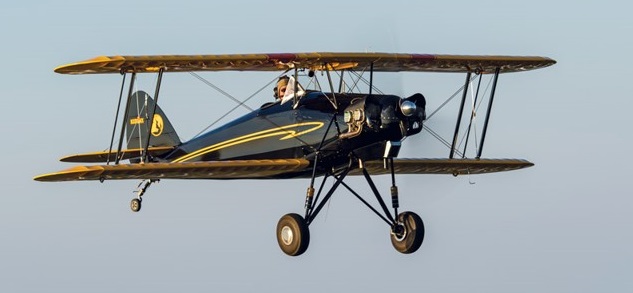
The Skyotë is a plans-built aircraft design dates back to the 1970s when it was created by Pete Bartoe. His goal was to create a plane that was affordable and easy to fly, with enough performance to be competitive at the International Aerobatic Club’s Intermediate level.
Bartoe met his design goals, and the delightful handling qualities of the Skyotë were praised by R.A. “Bob” Hoover in a flight report that appeared in the December 1976 issue of Sport Aviation.
The Skyotë uses a biplane planform, with a swept wing. It has a single seat, tube-and-fabric fuselage with an all-aluminum structure, and fabric-covered wings stressed for +9/-6 G. Weight and performance qualify it for the Light Sport category, and it uses a Continental O-200 engine.
The airplane is not a typical plans-built homebuilt. Bartoe did not design it with homebuilding in mind; his intention was factory production.
Because the goal was good aerobatic performance on minimum horsepower, each part is optimized for its purpose. As a result, parts are made from six gauges of aluminum, seven gauges of steel, and three gauges of stainless steel. The 7.2-degree wing sweep looks and performs great, but is hard to build. Brackets in the wings have left, right, top, and bottom positions, so one part can have four different bending configurations depending on what wing location you’re building. The mounting clips for the wing ribs have an acute angle on one side and an obtuse angle on the other side.
Although the Skyotë didn’t make it to production, Bartoe sold around 100 sets of plans. Twelve airplanes have been completed from the original plans, but about half of those were factory prototypes. The first, N8XX, first flying on 23 April 1976 powered by a 90hp Continental C-90F.
John Roberts was one of those people who ordered a set of plans. But when he received them, it didn’t take long to discover why only five builders had completed their airplanes after nearly 40 years—the drawings were incredibly complicated, and the skill level required was way beyond the ability of most potential builders.
Roberts decided to use modern technology to get his plane, Skyotë #88, into the air, as the Tech-Built Skyotë.
Knowing that Pete Bartoe had mathematically calculated all Skyotë dimensions to an accuracy of three decimal places for all three axes led John to see the combination of Skyotë plans and 3D CAD as a better way to have the Skyotë he wanted.
While learning Geomagic 3D CAD software, John selected parts from Bartoe’s drawings and created CAD models for each part. Over time, he ended up with more than 150 drawings depicting nearly 600 parts that needed to be fabricated for the Skyotë.
The software’s 3D modelling feature produces assembly drawings that are very easy to understand. By assembling the parts in “virtual space,” you can be sure that all of the parts will fit together correctly.
The CAD program also confirmed the accuracy of Bartoe’s original calculations. With a total of nearly 1000 pieces in the Skyotë and tens of thousands of holes, John discovered only one small error—a single hole was off about 1/32 inch. That discrepancy has been corrected.
To convert his .dfx files into parts a waterjet cutting process cut about 600 flat metal parts to make fittings for the wings and fuselage.
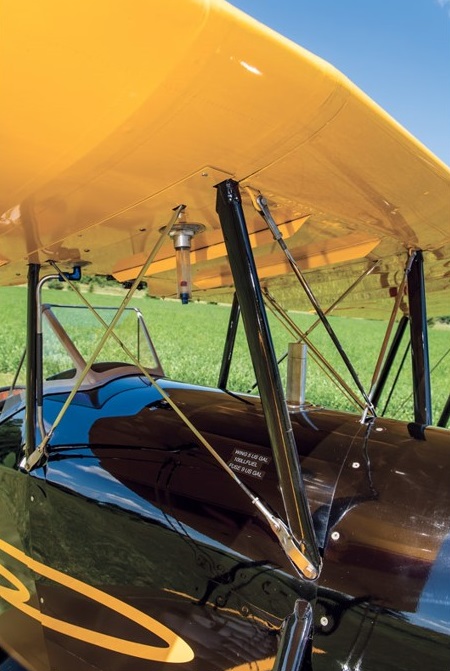
In the wings there are three compression struts between the front and rear spars, along with drag and anti-drag wires, and one tubular brace out at the tip.
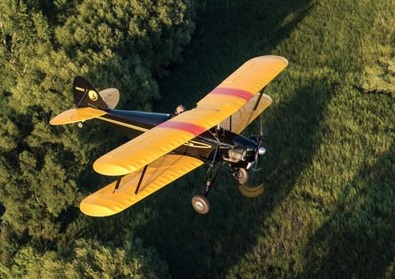
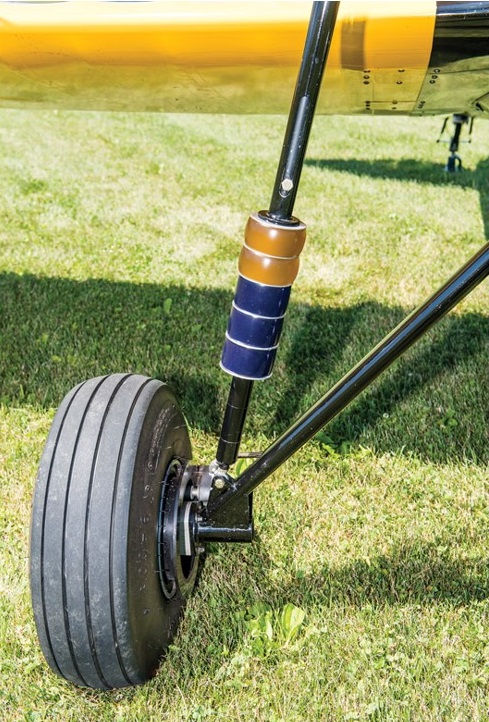
The fuselage is welded steel tube construction with fabric covering. The standard gear uses bungee shocks, and by all reports, it works just fine. A shock strut that uses urethane donuts with various amounts of stiffness for the Tech-Built Skyotë is simple to adjust the amount of bounce, and the donuts are unlikely to wear out.
Engine: Continental O-200, 100 hp
Prop: Catto 2-blade fixed pitch
Wingspan: 20 ft 0 in
Length: 16 ft 3 in
Empty weight: 656 lb
MTOW: 975 lb
Fuel capacity: 15 USG
Full fuel payload: 229 lb
Cruise: 90 kt
ROC: 1200 fpm
Landing speed: 40 kt
Stall: 38 kt
Takeoff roll: 300 ft
Landing distance: 550 ft
Load rating: +9 G/-6 G
Cabin width: 20.25 in
Seats: 1
Engine: 118hp Lycoming O-235-K2A
Wingspan: 20’0″
Length: 16’3″
Useful load: 297 lb
Max speed: 157 mph
Cruise: 112 mph
Stall: 44 mph
Range: 207 mi
Seats: 1
Jerry Morris has over 20,000 flight hours. He was an Air Force C-130 pilot, flew civilian charter for several years, and then was a captain for Delta Air Lines.
I had an opportunity to fly a Skyotë, and what a blast it was.
Climbing in was really not bad, even for an old guy like me. Left foot in the step on the fuse and swing your right leg up and over, and into the single seat. There is a very sturdy handhold conveniently placed in the center of the upper wing that really helps here. Sliding down in, the cockpit rails are tight, but once settled in, they barely rubbed on my shoulders, and it was really comfortable. The low windscreen proved to be very effective, and the visibility all around was open-cockpit superb. All the controls and switches were very accessible and required no stretching or reaching. Very nice.
The little Continental O-200 had already been run this day, so mags on, throttle cracked, mixture in, and crank away. A couple blades later it was up and running. Everything in the green and off I went.
Visibility was actually pretty good taxiing. Slight S-turning was all that was needed. Toe brakes were hardly needed, and the steering through the rudders was very effective but not twitchy. Runup is standard, and I was ready to go.
The Skyotë is a light plane and even with just 100 hp accelerated quickly. By the time I had the power all the way in, the tail was up and ready to fly. Directional control was not an issue, and I was off. Climbing at 70 brought a solid feel with not too high a pitch attitude and excellent visibility. Once out of the pattern, I went up to a higher altitude to play a little.
This thing turns on a dime. Rudder is required, but not much. I led with just a touch, then aileron, and around we went. Same for rolling out. After just a couple turns, it became second nature. It has very light controls, both roll and pitch, and fingertip pressure is all that’s needed to fly. It was easy to trim with the electric trim on the elevator, but there was not a lot of pitch change to trim out with speed changes.
Slow flight at 60 is easy. With power off and holding the nose up, I started feeling the burble in the low 40s. There was an easy break, and the times I stalled it, it wanted to break ever so slightly to the left. A touch of rudder with center stick, though, and I could keep it level. It was very docile.
Steep turns, wingovers, and hammers are all textbook simple and very honest. All the while I enjoyed the great visibility through the wings that seemed to be placed just right for seeing through.
Back to the pattern with my dancing shoes on. In typical carbureted fashion, carb heat on abeam the numbers. I used 70 on base, and once established on final back to 60 indicated. There’s pretty good drag, so with my usual picture, I carried a tad of power down final. Bleeding off over the numbers in the flare, I three-pointed it at just over 50 indicated. Directional control was great, and visibility just out the side of the cockpit was typical taildragger, with not much over the nose. Carb heat and power in, and off I went again.
Next I tried a wheel landing. Same pattern with just a tad of power to keep the speed up for the touchdown. John’s gear is forgiving and wheelies will be simple with just a few tries. Visibility is great with the tail up, and the rudder is very effective. I went up one more time to the final landing, which was basically a repeat of the first. It three-points very nicely and tracks true down the runway with minimal rudder required. Touching down around 50 produces a nice short landing roll, then back to the barn I went, wearing a big grin.
This little ship is a joy to fly, with fingertip controls that are well balanced. Stable in pitch and roll, it didn’t wander around while I was enjoying the view. And what a view! Flying wires and wings were everywhere, but they were easy to see through. In steep turns, looking behind the top wing gives a great view. On the ground, it’s very honest with pretty good visibility. This is the type of plane that’s made for early-morning or late-afternoon jaunts in the country. And, it’s rumored to do great aerobatics.
Thanks so much to John for letting me fly his pride and joy.
—Jerry Morris
Ron Schreck Flies the Skyotë
Ron Schreck, a current IAC competitor and judge, to give us an evaluation of the aerobatics.
John’s home field is at Rock Hill, South Carolina (KUZA), just a 15-minute flight from my home at Gold Hill Airpark, North Carolina (NC25). I arrived on a calm, clear morning in late October. With temperatures in the mid 50s, I was glad I brought along a leather jacket, scarf and gloves.
John gave me a quick introduction to the simple VFR cockpit. Startup was routine and taxi was uneventful. After a brief runup I rolled out to the centerline of Runway 02. Even with the Catto cruise prop, the Skyotë was airborne before I had a chance to wander far from the centerline. I’m guessing that about 400 feet is all it took to take to the air! I found the climb to be a bit lethargic due to the cruise prop, and I would certainly recommend a lower pitched propeller for those interested in serious aerobatics. John tells me he gets a 10-knot boost in top speed with the cruise prop.
Once at altitude I put the Skyotë through some aerobatics. With no inverted systems and lacking dual seat belts and/or parachute, I avoided negative-G maneuvers. Elevator and rudder are quite responsive throughout the flight envelope. Entry to spins, right and left, was a simple matter of pulling power, waiting for the stall (which comes quickly due to the inherent drag) and applying full left or right rudder for a clean entry. Recovery was rapid, with slight opposite rudder and releasing back pressure. The responsive rudder and elevator also make the Skyotë a champion at snap rolls! I found that about 70 knots is the sweet spot for snap entry. A quick tug on the stick, rapidly followed by generous rudder, and the Skyotë eagerly snaps in either direction quite rapidly. The sweep of both upper and lower wings undoubtedly contributes to such great snaps!
Loops must be quite tight as the airplane decelerates quickly when the nose comes up, and you can find yourself out of energy at the top unless you pull with at least 3.5 or 4 G’s at the start. Here again, a climb prop would help out. Aileron rolls are a two-handed affair in the Skyotë, as the ailerons become quite heavy as airspeed increases. The aircraft rolls nicely, but the stick pressure required is not in keeping with the light pressures required for pitch and yaw control. I would like to see if the addition of spades to the ailerons would help. During non-aerobatic flight, the heavy ailerons do not seem to be so obvious.
Landing is pretty much a non-event. You will likely lose sight of the runway through the final turn, as it is blanked out by the upper wing. It will come back into view on final, and visibility over the nose on final and throughout the flare is no problem. I did a wheel landing on the first pattern with no issues. A three-point is another option, and I found that the tailwheel can touch down first without really trying. John did caution me to carry just a bit of power through the flare to avoid an excessive sink rate as the speed rapidly drops off with the throttle closed. Elevator and rudder control are positive in all landings.
For some serious aerobatics you would want to add inverted systems and dual ratcheting seat belts. A parachute would be required for IAC competition. There is little room for a backpack parachute, and pilots with long torsos may have trouble finding a seat-pack ‘chute that will allow you to get low enough in the seat. A chest-pack ‘chute may be a reasonable solution. Some experimentation with different parachutes and/or some modification to the seat may be in order.
Overall, I found the Skyotë to be a docile airplane that packs a lot of fun in a very small package. It is certainly capable of flying IAC competition aerobatics at the Sportsman level and even at the Intermediate level in the hands of an experienced pilot. My thanks to John Roberts for letting me enjoy his ride.
—Ron Schreck
 All Aero