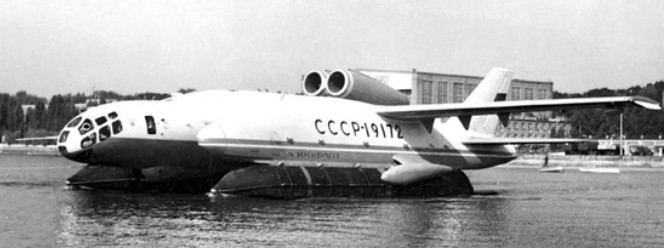
A team led by Roberto Oros di Bartini, a communist who had left fascist Italy for the USSR, presented in 1955 the project of a supersonic flying A-55 medium-range bomber boat. After the comprehensive development and improvement of this project, Bartini approached the creation of an amphibian vertical take-off and landing (SVVP in its Russian acronym).
The experimental vertical take-off and landing amphibian VVA-14 (In Russian: ВВА-14) was characterized by the originality of its design and both its size and its take-off weight surpassed all VTOL aircraft built or projected at the time.
The VVA-14 antisubmarine amphibian began to be developed by government resolution in November 1965 at the UVZ helicopter factory (УВЗ – Ухтомскый Вертолетный Завод) and later transferred to Beriev’s OKB in Taganrog which was later would become the Taganrog Aviation Scientific-Technical Complex (TANTK).
In the process of development of the VVA-14 in the UVZ, together with Bartini participated the helicopter manufacturer VI Biriulin and the later general constructor MP Símonov. In the TANTK NA Pogorielov and GS Panatov were added, who would also later become general constructor. The main objective of the project was to develop new aerial means to combat missile-armed submarines, so it was decided, based on the experimental results, to create an amphibious anti-submarine device capable of detecting, tracking and destroying submarines, both on the surface and while submerged. This requirement demanded an autonomy of 4 hours of flight over an area located 500 km from the base. The development of search and rescue missions was established as a secondary objective.
After the analysis, a conceptual scheme based on the SVVP-2500 design was decided. It was a catamaran-like structure with a rectangular centroplane and a central fuselage in which 12 turbojets were located designed to achieve lift force in vertical take-off. Above the centerplane were two two-stage turbojets for horizontal flight. So-called PVPUs (пневматическое взлетно-посадочное устройство – pneumatic equipment for take-off and landing) were used for landing and take-off operations on water. This unusual composition and the great technical difficulties that arose made it necessary to incorporate researchers and engineers from TsAGI into the development., LII, TsIAM, VIAM and NIAT.
It was decided to develop two prototypes: the VVA-14-1M destined to carry out the functional tests of the selected composition in the different operating regimes and the VVA-14-2M to carry out the vertical take-off and landing tests and the processes transition to horizontal flight.
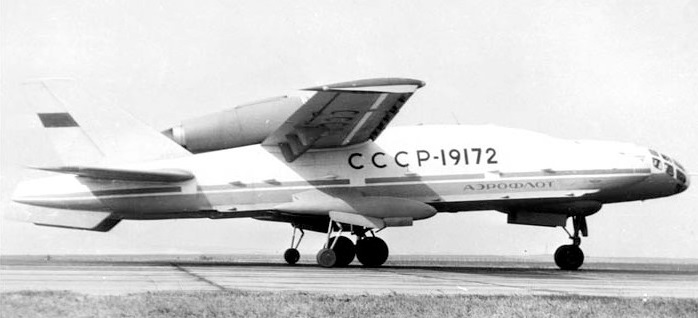
In the late 50s – early 60s, he created the SVVP-2500 vehicle with a take-off weight of 2500 tons in the form of a flying wing with a square center-section and consoles and a power plant made from lifting and cruising engines. In June 1972, the construction of the VVA-14-1M was completed, which did not include the vertical thrust engines and the floats. In July at the TANTK aerodrome, test runs of the prototype began, which was equipped with wheeled landing gear and on September 4 the first flight with pilot Yu took place. M. Kuprianov at the controls and LF Kusnietsov as a navigator. The flight tests that were carried out until June 1975 with a total of 107 flights with a total duration of 103 hours, reaching a maximum speed of 260 km / h.
The VVA-14 was built as a cantilever high wing structure with a supporting centerplane and consoles to which the tailplanes and vertical fins were attached. These cigar-shaped gondolas were designed to contain the PVPU floats. The construction was made fundamentally of aluminum alloys and cadmium steel with anticorrosive coating in attention to the marine operation.
The fuselage was of semi-monocoque construction and was fused with the centroplane to achieve a supporting fuselage. In the bow was located the cockpit for a crew of three. This cabin could be detached from the fuselage in an emergency and ensured the life of the crew without the need for ejection seats.
Behind the cockpit was located the lift engine module consisting of 12 Kolosov RD-36-35PR (РД-36-35PR) turbojets and the weapons bay.
The wing was composed of the rectangular-shaped centroplane and the outer sections called OChK of trapezoidal shape with a positive dihedral of 2º. These sections featured flaps along the entire trailing edge, ailerons and flaps.
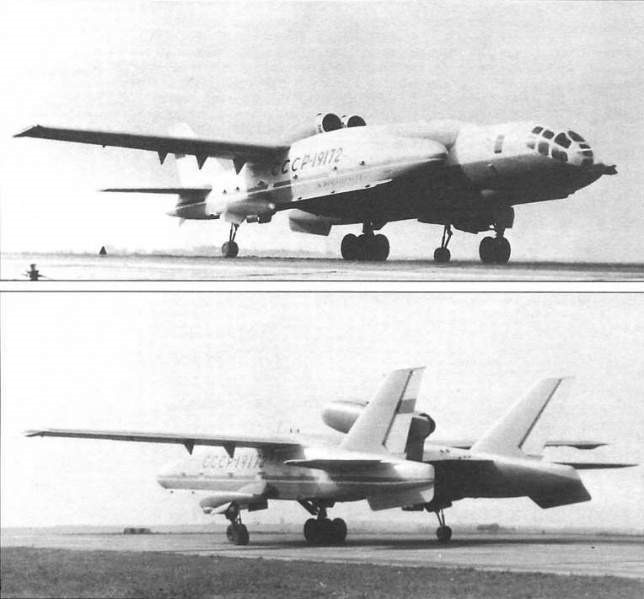
The tail planes were of the cantilever type with a sag of 40º at the leading edge and a surface area of 21.8 m². The elevator had an area of 6.33 m². The two vertical surfaces had a total area of 22.75 m² with a sag of 54º. The area of the rudders was 6.75 m².
The PVPUs (Pneumatic Takeoff and Landing Equipment) were made up of floats 14 meters long, 2.5 meters in diameter and a volume of 50 m3 made up of 12 sections. For its extension and retraction, a complex mechanical-hydro-pneumatic-electric system was used with 12 cylindrical injectors (one for each section). The air for filling was supplied by the compressors of the driving engines. A retractable tricycle landing gear was designed to transport the aircraft over land, with the front landing gear fixed to the fuselage and the main landing gear located on the inner surface of the nacelles. Each undercarriage mounted two wheels.
The combined powerplant consisted of two Soloviov D-30M double-contour turbojets with a thrust of 6800 kg for horizontal flight, located next to each other on separate consoles on the rear of the centerplane and 12 Kolosov RD-36 ascending turbojets. 35PR of 4400 kg each located in pairs with a certain forward inclination in the space of the fuselage behind the cockpit. At the top, an upward opening hatch for each pair of engines covered the air intakes. At the bottom were the nozzles with an adjustable angle of incidence. The use of an auxiliary turbocharged engine was assessed during the project.
The fuel system consisted of 14 tanks for a total capacity of 15,500 liters. A refuelling system at sea was devised.
The steering system of the aerodynamic surfaces was conventional, but in the case of vertical operations and the regime of transition to horizontal flight, 12 additional levers operated in pairs were conceived that allowed the control of the compressed air of the lift engines. The autopilot system allowed course control in all flight regimes.
The flight surfaces had a hot air anti-freeze system and the engines had a fire protection system.
The crew cabin had an oxygen and air conditioning system. An automatic stabilization system was designed to be used during vertical take-off and landing operations and horizontal flight in adverse weather conditions. In the search and rescue version, the VVA-14 was also designed with radio marking systems. The antisubmarine version had to use a Burevietnik search system capable of locating enemy submarines and coordinating the data necessary for their destruction. To detect the submarines, it was planned to equip the VVA-14 with 144 RGB-1U hydroacoustic buoys (РГБ-1У) and up to 100 noise generators, in addition to a Bor-1 magnetic anomaly detector. (Бор-1).
The armament for the antisubmarine version would be located in a hold in the fuselage with a capacity for 2000 kg, being able to incorporate two naval torpedoes or eight IGMD-500 aviation mines (ИГМД-500) or 16 PLAB-250 aviation bombs (ПЛАБ-250). The use of a survival system equipped with active and passive interference launchers was also designed.
In 1974 they settled the VVA-14-1M the PVPU developed at the Bureau of Construction Aggregates of Dolgoprudniencsky and produced in Yaroslavsk, with two large inflatable floats deployed at the bottom of the gondolas. The tests began on June 11, 1975 and included the inflation and collection of the PVPU, which showed that the operation was quite complex and the solution still had to be worked on.
Between 1974 and 1975, 106 cycles of expansion and collection of the PVPU were carried out of which 11 were carried out in flight, both from the water and from the ground.
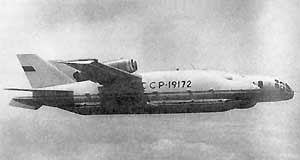
Flight tests confirmed the calculations and showed that at the bottom of the 10.75-meter chord centroplane an effective air cushion was formed at 10 – 12 meters high during landing and at 8 meters the cushion was so dense that test pilot Yu. M. Kuprianov on more than one occasion asked to be allowed to release the controls so that the machine would settle on its own.
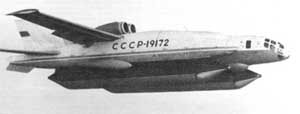
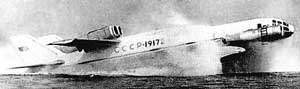
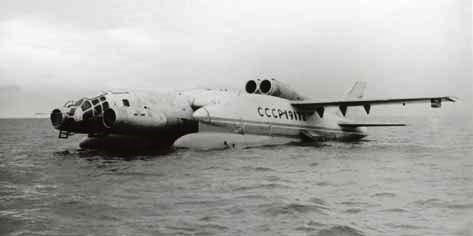
The VVA-14 never made the vertical take-off and landing. The engines for this purpose were never ready. The VVA-14-1M was modified with the installation in the bow of two Soloviov D-30M engines destined to blow and create the air cushion under the centerplane, using the aircraft as an ekranoplane. Among the main modifications made, the inflatable floats were replaced by metallic ones. This model received the designation 14M-1P and was successfully tested in 1976 on the Taganrog peninsula in the Sea of Azov.
Today the remains of this project are preserved in the VVS Museum of Mónino.
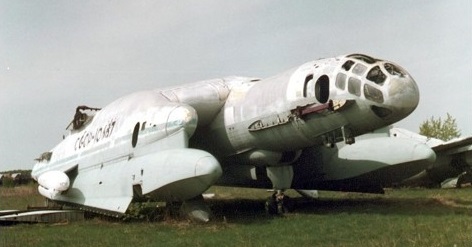
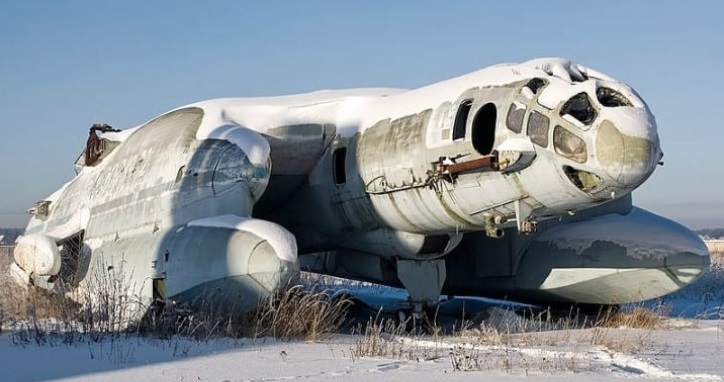
VVA-14
Powerplant: two Soloviov D-30M double-contour turbojets, 6,800 kg and 12 Kolosov RD-36-35PR, 4,400 kg
Wingspan: 30.00 m
Wing area: 21.77 m²
Length: 25.97 m
Height: 6.79 m
Empty weight: 35356 kg
Maximum takeoff weight: 52,000 kg
Fuel weight: 14000 kg
Normal military load: 2000 kg
Maximum military load: 4000 kg
Maximum speed: 760km / h
Cruising speed: 640 km / h
Patrol speed: 360 km / h
Practical range: 2450 km
Practical ceiling: 8000-10000 m
Armament: 2 x naval torpedoes / 8 x IGMD-500 aviation mines (ИГМД-500) or 16 PLAB-250 bombs (ПЛАБ-250)
Accommodation: 3 crew
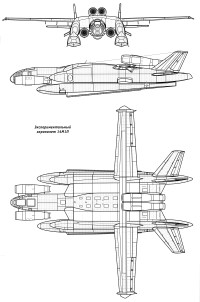
 All Aero