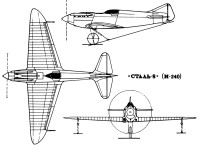
The Stal-8 (In Russian: Бартини Сталь-8) (I-240 in the VVS designation ) was a more practical development of the Stal-6 as a fighter.
It was longer than its predecessor, by the use of a an M-100A (licence-built Hispano Suiza 12YBR) 860 hp engine and was characterized by the presence of a protruding cabin in the upper fuselage, to maintain aerodynamic cleanliness. Unlike the Stal-6 the pilot’s seat was fixed in its upper position.
The Stal-8 construction was mainly the aluminum-magnesium alloy Altmag. The joints were made by spot welding. The cooling system and landing system were very similar to those of the Stal-6. Two 7.62mm ShKAS machine-guns were to be fitted in the top decking over the engine, synchronised to fire through the propeller.
Structurally, the Stal-8 featured a monocoque fuselage formed from metal slats with a C-type profile. The wing was built around two spars with stamped steel ribs. Altmag’s wing coating, 0.5mm thick on the top and 0.8mm thick on the bottom.
The forward part of the wing included the evaporative cooling system. The ‘enerzh’ double skinned surface-evaporation radiators formed the leading edge skin, back to the main-spars. The 4-section ailerons were located on the trailing edge, which could be used as flaps during takeoff, landing and turns. Like the Stal-6, it maintained the system for varying the angle of incidence of the elevator rudders as a function of flight speed.
The 175-liter fuel capacity was achieved through two tanks located near the wing root. The oil tank upper part formed part of the surface of the fuselage in front of the cockpit. In this way, at high speeds, the oil was cooled by the air flow itself.
Construction of the Stal-8 was started in the ships of Factory No.240. Work on the prototype was suspended in late 1934, when work was at approximately 60%. The reasons were various, among them because the GVF, in whose institute Bartini’s brigade worked, was not very in favor of generating military devices in its facilities that did not contribute to their needs. On the other hand, the State Directorate for the Aeronautical Industry (GUAP) did not pay much attention to the project either, considering it “foreign” as it was a responsibility of the GVF. The new Polikarpov fighters I-15 and I-16s were being produced and although the Stal-8 was superior in many respects, there were great doubts about the vulnerability of the cooling system.
Stal-8
Engine: Mikulin M-100, 860 hp (licensed Hispano-Suiza Ybrs)
Wingspan: 9.60 m
Wing area: 15.30 m²
Length: 8.22 m
Height: 2.23 m
Empty weight: 1100 kg
Maximum takeoff weight: 1740 kg
Fuel capacity: 250 kg
Wing loading: 100 kg / m²
Power load: 1.75 kg / hp
Maximum speed at sea level: 550 km / h
Maximum speed at 3000 m: 630 km / h
ROC: 20 m / sec
Practical range: 180 km
Practical ceiling: 9500 m
Endurance: 2.4 hours
Range: 800 km
Take-off run: 190 m
Accommodation: 1
 All Aero