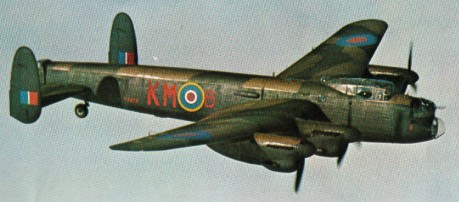
Owing to delays in the full development of the Vulture engine, the decision was taken in mid-1940 to design a new version of the Manchester with four Rolls-Royce Merlin engines. The first conversion made use of about 75 per cent of the Manchester’s parts and assemblies, the principal change being the provision of a new centre-section of the wing with mountings for Merlin engines. This aeroplane became the first prototype of the Lancaster mading its first flight on 9 January 1941. A second prototype fitted with Merlins and significantly modified in detail was designed, built and flown in just eight months.
The first production Lancaster I flew just over five months later, its was powered by four 954kW Rolls-Royce Merlin XX in-line liquid-cooled engines, each driving a three-blade constant-speed and fully feathering propeller.
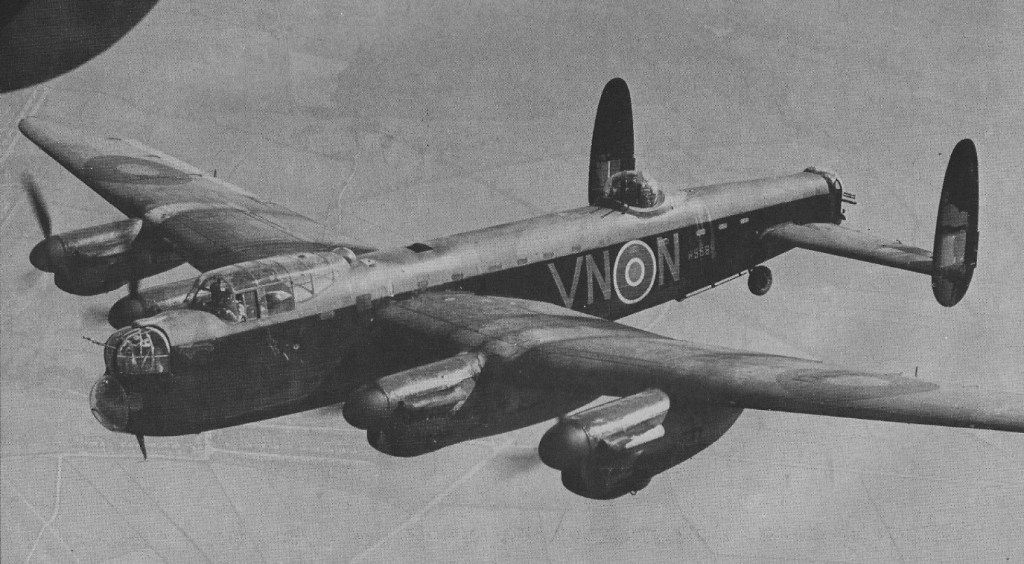
By 1942, the Mk I was now redesignated with the more traditional B.Mk I naming convention. The system was put into full production at such a pace that the aircraft production lines were outpacing the engine lines. The American Packard company developed the same Merlin engines for shipment back to England. As further insurance, the Bristol company was in line with its own Hercules VI and XVI engines capable of 1,735 horsepower.
The Lancaster II was built with 1,229.5kW Bristol Hercules VI radial engines but only 300 Lancaster IIs were built.
The first of Bomber Command’s squadrons to be equipped with the Lancaster was No 44 based at Waddington, Lincs, in early 1942. No 44 used them operationally for the first time on 3 March 1942 laying mines in the Heligoland Bight.
Improving engines provided improving performance: the Lancaster VII, with 1,207kW Merlin 24 engines, had a maximum take-off weight of 30,844kg by comparison with the 22,680kg of the early Lancaster I. The bomb bay was modified progressively to carry the 9,980kg Grand Slam bomb.
Six major companies built 7377 aircraft at ten factories on two continents; at the height of production over 1,100,000 men and women were employed working for over 920 companies.
The Lancaster operations included the breaching of the Mohne and Eder dams on the night of 16-17 May 1943 by No 617 Squadron (led by Wing Cdr Guy Gibson); and the sinking of the German battleship Tirpitz.
During World War II 608,612 tons of bombs were delivered in 1156,000 sorties, which represented two-thirds of the total bomb load dropped by the RAF from March 1942 to May 1945. At wars end there were 56 squadrons of Lancasters in RAF Bomber Command.
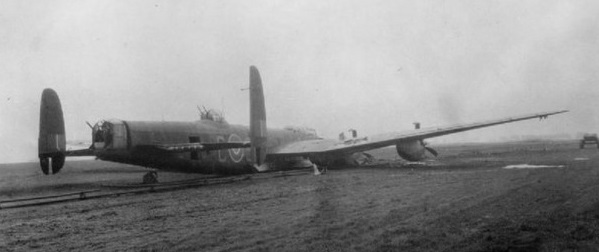
On average Lancasters completed twenty-one missions before being lost.
From 1951 until early 1953, France took delivery of 54 reconditioned Lancasters for maritime patrol, general reconnaissance and search and rescue (SAR) work 32 Mk Is and 22 Mk VIIs.
In all 13 French Lancasters were destroyed in accidents, or struck off charge following damage. The bulk of the fleet was withdrawn and scrapped with the arrival in strength of the Neptunes in 1958 1959. Others served on with the surviving Escadrilles de Servitude until 1961 1962.
It fell to 9S in New Caledonia to be the last French unit to operate Lancasters, giving them up operationally in 1964, ferrying the last two to preservation in April (No 13) and August (No 15) that year.
In Canada, 408 Squadron, RCAF, withdrew its last Mk X examples in March 1964 at Rockcliffe.
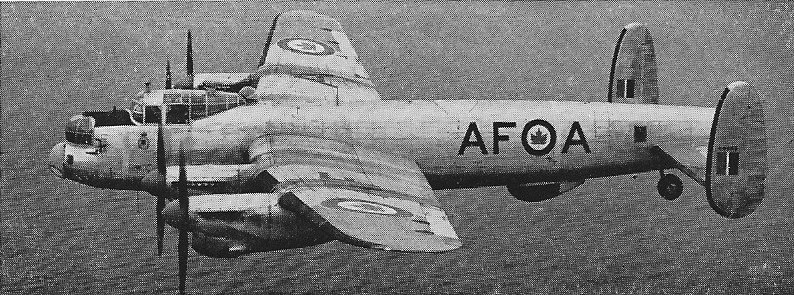
Victory Aircraft in Malton (Toronto), Ontario, produced over 400 Lancaster Mk X’s. The basic aircraft built in Canada was the Lancaster 10-B. Eight were converted for photo-reconnaissance as Lancaster 10-Ps in 1948, and others were converted to Lancaster 10-ASR (Air-sea rescue) and 10-BR (Bomber-reconnaissance) during 1949-50. The Lancaster 10-MR maritime reconnaissance aircraft succeeded the 10-BR, the first conversion flying on 29 December 1950.
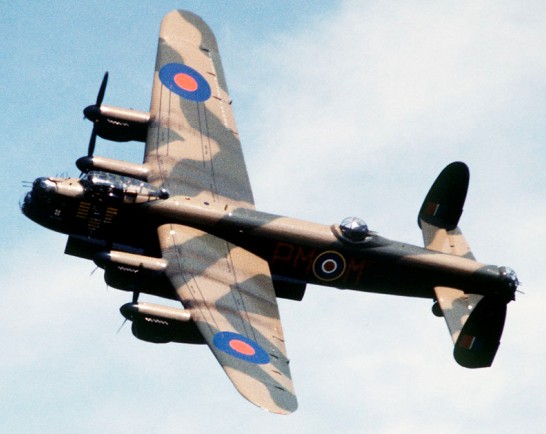
Lancaster on Tour 1946 Article
Of the 7366 Lancasters built, all but 300 radial engines Mk.IIs had Merlin engines of 1460-1640 hp. All carried a crew of seven. 3487 were lost on operations over Germany during WW2.
Avro Lancaster I
Engines: 4 x Rolls-Royce Merlin XX, 1280 hp(955 kW) or Rolls-Royce Merlin 22, 1460 hp(1089 kW) or Rolls-Royce Merlin 24, 1640 hp(1223 kW)
Wing span: 31.09m
Length: 21.18m
Height: 6.25m
Wing area: 120.49sq.m
Empty eight: 16,783 kg
MTOW: 30,845 kg
Max speed: 44s kph @ 4570m
Range: 4072 km
Armament: 9 x 7.7 mm Browning mg
Bombload: 9979 kg
Avro 683 Lancaster Mk I
Engine: 4 x Rolls Royce Merlin XXIV, 1618 hp
Length: 69.488 ft / 21.18 m
Height: 20.013 ft / 6.1 m
Wingspan: 102.001 ft / 31.09 m
Wing area: 1296.954 sq.ft / 120.49 sq.m
Max take off weight: 70013.2 lb / 31752.0 kg
Weight empty: 36907.3 lb / 16738.0 kg
Max. speed: 249 kts / 462 km/h
Cruising speed: 183 kts / 338 km/h
Service ceiling: 24606 ft / 7500 m
Cruising altitude: 20013 ft / 6100 m
Wing load: 54.12 lb/sq.ft / 264.0 kg/sq.m
Range w/max.fuel: 3600 km / 2237 miles
Range w/max.payload: 1800 km / 1118 miles
Range with 14,000 lb. (6,350 kg.) of bombs: 660 miles (2,700 km.).
Crew: 7
Armament: 10x MG 7,7mm, 8185 kg Bombs
Lancaster II
Engines: 4 x Bristol Hercules. Length: 70ft.
Lancaster III
Length: 69 ft 6 in
Wingspan: 102 ft
Top speed: 275 mph
Armament: 8-10 x .303 mg
Bomload: 18,000 lb
Crew: 7
Range: 2530 miles
Lancaster X
Type 7 Seat Heavy Bomber
Engines: 4 x Rolls Royce Merlin 224, 1620 hp
Wing Span: 102 ft (31.1 m)
Length: 69ft 6″ (21.1 m) “
Height: 20ft 4″ (6.2 m)
Speed: 272 Mph (438km/h)
Armament: Nose and Dorsal Turrets with two 0.303in Brownings, tail turret four 0.303in Brownings. Bombs-14,000lbs – 22,000lbs with modification
683 Lancaster 10-MR
Engines: 4 x Rolls Royce Merlin 224, 1620 hp
Empty weight: 41,000 lb
Loaded weight: 68,000 lb
Max speed: 250 mph
Cruise: 216 mph
Range: 2250 mi
Wingspan: 102 ft
Length: 68 ft 10 in
Height: 20 ft
Wing area: 1297 sq.ft
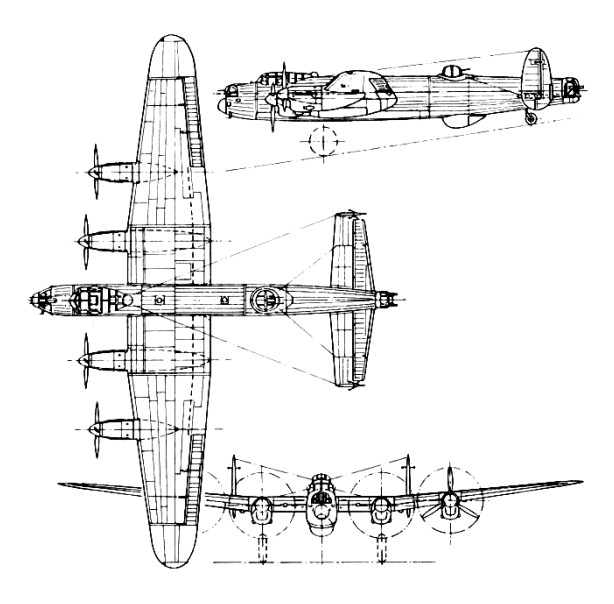
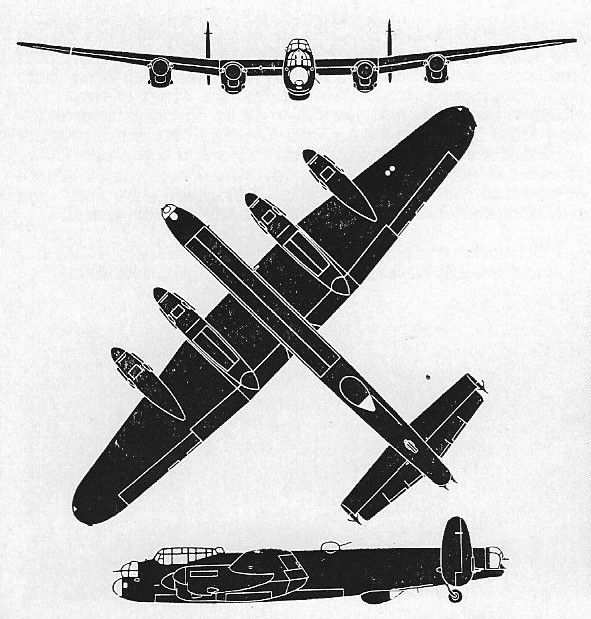
 All Aero