
With the UK staging the first post-war Schneider Trophy contest in 1919, Avro decided to build and enter an aircraft, the Avro 539. In order to achieve the highest possible speed, it was the smallest practical single-engined aircraft that could be designed around the selected powerplant, a Siddeley Puma inline engine. An unequal-span biplane, with ailerons on both wings, it was of conventional construction with two single-step floats that were long enough to eliminate the need for a third float beneath the tail. First flown on 29 August 1919, only 12 days before the day of the race, the Avro 539 had performance that was considered to be generally satisfactory. However, when taking off from Cowes to take part in the seaworthiness trials, which were a compulsory preliminary to the speed contest, a float was seriously damaged by floating debris. Avro was given five days to repair, and used this time also to modify the tail unit. When the floatplane appeared again it carried the registration G-EALG, and because of the modifications was re-designated Avro 539A. When tested, its performance was not good enough to warrant selection for the speed contest, with the result it was delegated as the British reserve aircraft. The contest, held at Bournemouth on 10 September 1919 was a fiasco in foggy conditions and was abandoned.

The 539 was converted to a landplane and took part in the Aerial Derby of 1920, but force-landed with a fuel system leak. Then extensively modified, and with a 450 hp / 336 kW Napier Lion engine installed, it was re-designated Avro 539B. During tests before the 1921 Derby, the aircraft overshot on landing and was completely wrecked.
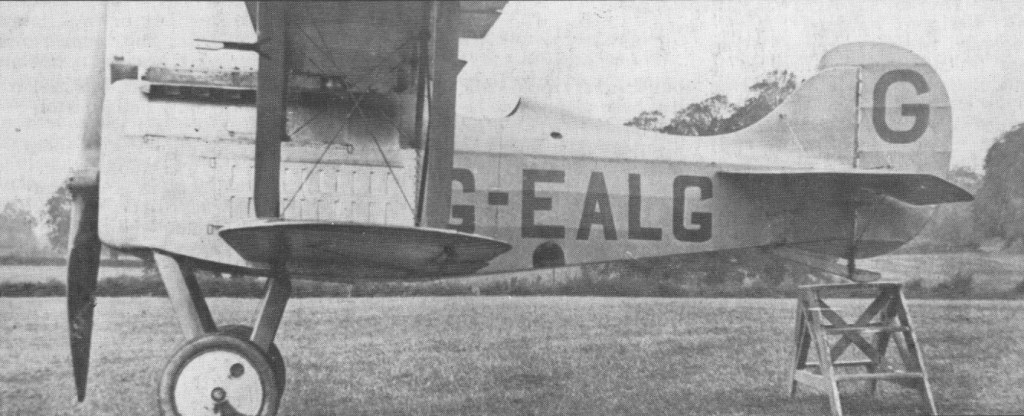
Avro 539
Engine: 1 x 240hp Siddeley Puma
Wingspan: Upper 25 ft 6 in / 7.77 m / lower 24 ft 6 in / 7.47 m
Length: 6.50 m / 21 ft 4 in
Height: 2.97 m / 9 ft 9 in
Wing area: 18.12 sq.m / 195.04 sq ft
Take-off weight: 962 kg / 2121 lb
Empty weight: 758 kg / 1671 lb

 All Aero