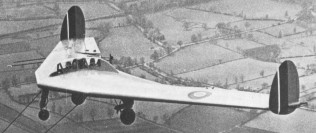
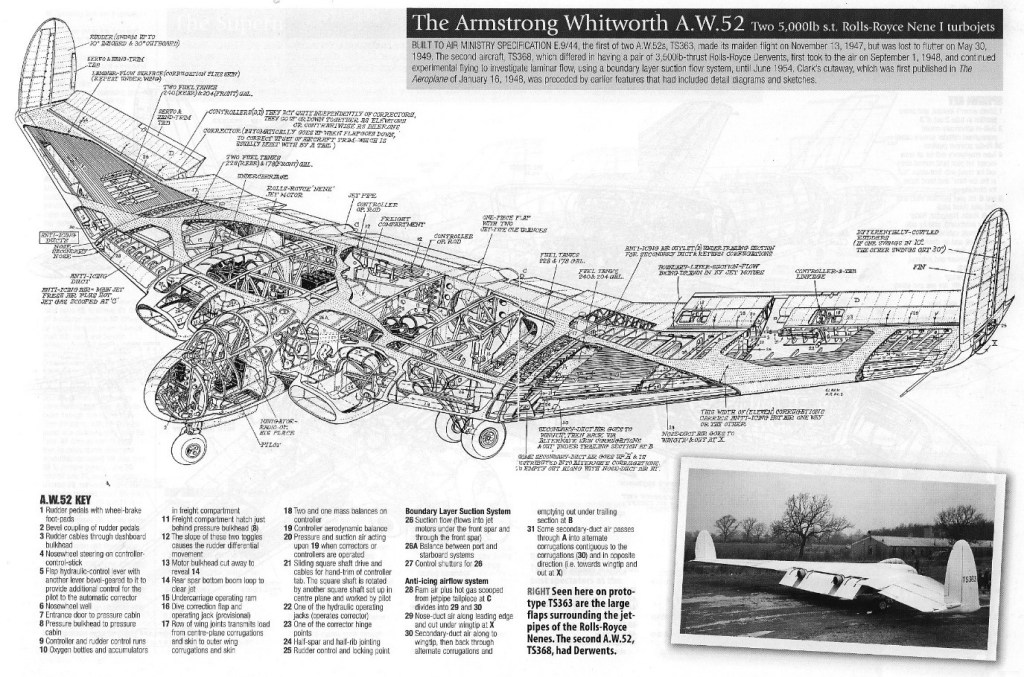
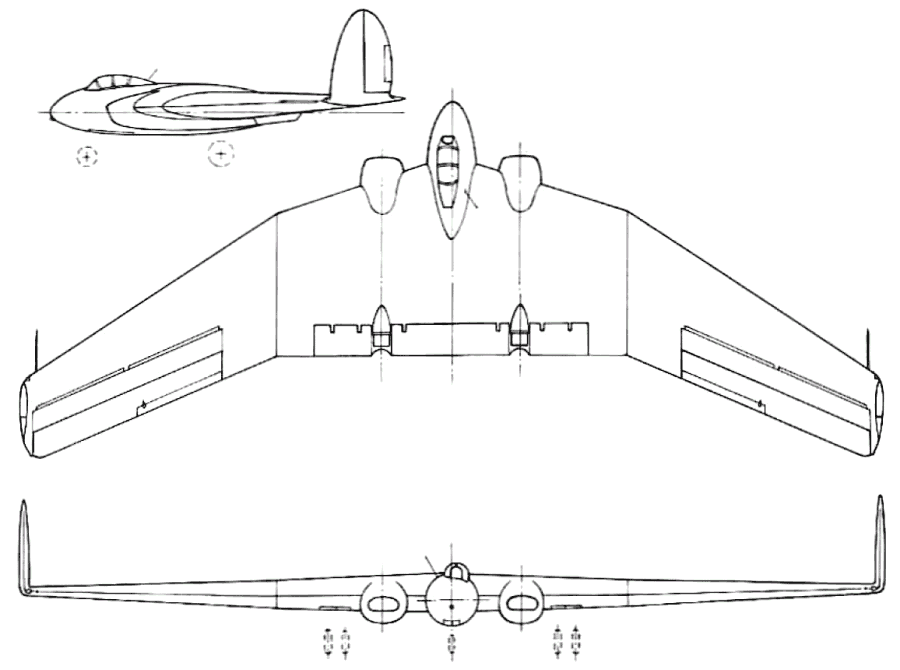
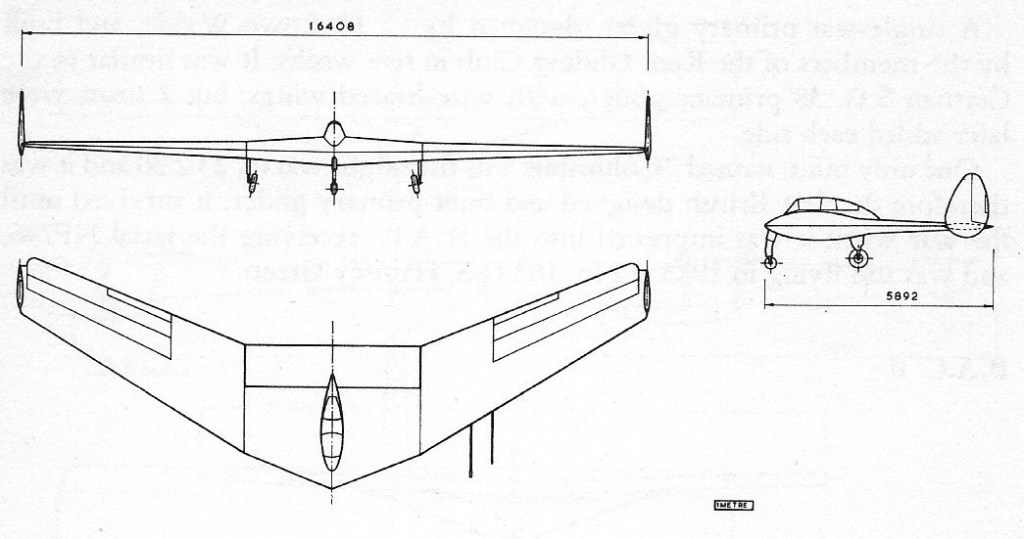
The Armstrong Whitworth A.W.52 was a flying wing type that was also intended to evaluate a configuration for a transport aeroplane with six jet engines. The basic design was validated in the A.W.52G glider.
The AW.52G was of conventional construction, but covered with “Plymax” material (1/16in ply and 22 SWG “Alclad” light alloy sheet). No airbrakes were fitted, but a central trailing-edge flap. The undercarriage was tricycle. Only one, RG324, was built. After testing was completed it remained at the company office until burnt in the mid-sixties.
The first of two A.W.52s with two 5000-lb (2268-kg) thrust Rolls-Royce Nene turbojets flew on 13 November 1947.
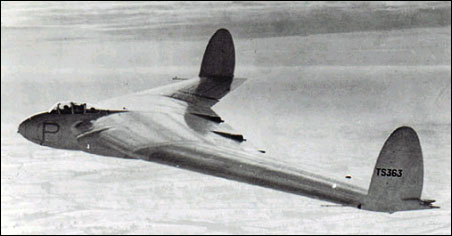
The first prototype, TS363, was lost in May 1949, its pilot being the first in the UK to use a Martin-Baker ejection seat in an emergency.
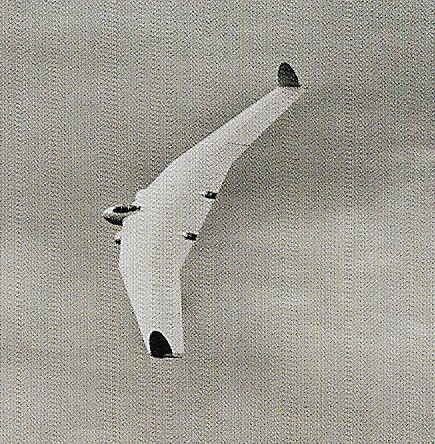
A second prototype, powered by Rolls-Royce Derwents, was destroyed early in its flight test programme.
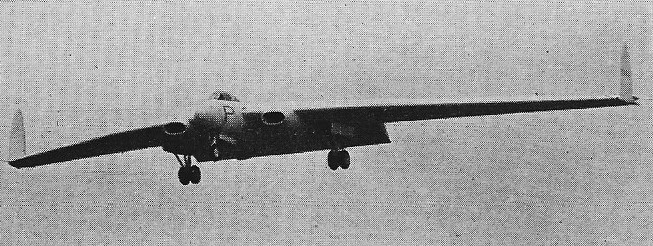
Although benefits were possible with such aircraft, financial problems finally curtailed the programme in 1950.
Engines: 2 x 2270kg Rolls-Royce Nene
Wingspan: 27.43 m / 90 ft 0 in
Wing area: 122.07 sq.m / 1313.95 sq ft
Length: 11.38 m / 37 ft 4 in
Height: 4.39 m / 14 ft 5 in
Take-off weight: 15490 kg / 34150 lb
Empty weight: 8917 kg / 19659 lb
Max. speed: 805 km/h / 500 mph
Range: 2414 km / 1500 miles
ROC: 4800 fpm
AW.52G
Wingspan: 16.40 m / 53 ft 10 in
Length: 5.89 m / 19 ft 4 in
Wing area: 41.14 sq.m / 443 sq.ft
Aspect ratio: 6.58
Wing section: NACA 2017
Empty weight: 2017 kg / 4451 lb
AUW: 2720 kg / 6000 lb
Max speed: 402 kph / 250 mph
Landing speed: 104 kph / 65 mph
 All Aero