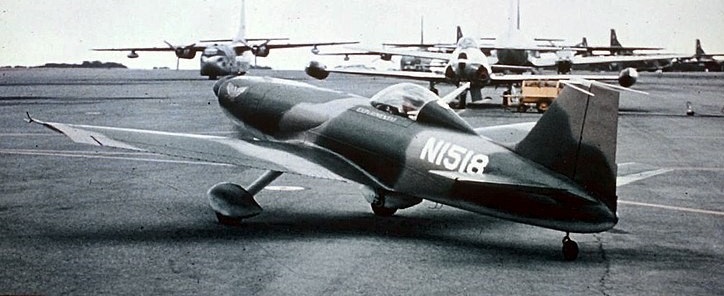
The American Electric Piranha (also named Blair-American USA or American USA was a prototype American counter-insurgency aircraft. Designed by Milt Blair and Dick Ennis in the early 1960s, developed from the LeVier Cosmic Wind, it was built by the American Electric Corporation.
Developed for use by the United States Air Force under Project Little Brother, initial flight testing of the Piranha took place at Mojave Airport in California; following delivery for evaluation, it was tested at Eglin Air Force Base in Florida. The design armament of the Piranha was two pods each carrying four Zuni unguided rockets, mounted on the aircraft’s wingtips, and a single 500-pound (230 kg) bomb on a belly hardpoint.
Evaluation of the Piranha ceased following the death of Milt Blair in an unrelated aircraft accident. The prototype, N1518, is flown by a private owner in Kansas. Possibly, seven examples were built and tested.
Bud Pinkston’s Piranha is thought to be the only one still flying, and by virtue of its serial number (USA-1) could be the original prototype. Bud even has an old company sales film touting the Piranha’s virtues to the military. In 1985, American Electric project engineer and Piranha designer Dick Ennis met Bud at an air show in Kansas. Dick was surprised to see the prototype No. 1 still flying and filled Bud in on the history of the Piranha.
When Bud finally got his hands on the Piranha, it already had 200 hours in the logbook, mostly military test time. The Piranha is all-aluminum construction and uses thick .050-inch skins throughout.
Bud believes the wing design was based on the aluminum Cosmic Wind Racer that Lockheed test pilots Herman Salmon and Tony LeVeir built and raced. The very beefy wing uses a built-up I-beam spar that angles forward from the root to the tip. The wing also uses solid ribs. Since the wet-wing tanks extend from the root rib to the tip rib, the ribs have flapper doors that act as one-way check valves to control fuel migration. Each wing holds 20 gallons of fuel, with a header tank making up another 20 gallons, for a total fuel capacity of 60 gallons (58 usable). Bud switches from left to right tank every 15 minutes to maintain roll trim.
The tapered wing starts with a symmetrical root rib, and there is considerable downward twist as the wing concludes at the tip. The wings have no flaps but do have 84-inch-long ailerons that span the full length of the wings. Only 8.75 square feet of aileron area is greatly responsible for the Piranha’s roll rate of 720 degrees per second. The first time Bud slapped the stick over, the roll was so abrupt that he slammed his head against the canopy and required four stitches in his right ear.
The fuselage is unique in that American Electric Corporation chose to hydro-form it from the cockpit aft. It was formed on the same plug they used to make napalm bomb casings. Notice the rear end cap under the rudder.
The cockpit is a model of simplicity and effectiveness. The canopy hinges on the right side and latches on the left. Two Piper-style latches are used to clamp the cockpit down and are accessible from inside or out. Once inside, the Piranha is placarded with a VSO of 80 kts (92 mph), and a VNE of 340 kts (391 mph). The VNE of 340 kts was the limit of the factory flutter testing.
Electrical switches are mounted on the lower left of the instrument panel. On the left side, the ammeter, tachometer, and airspeed indicator start to wrap around the panel. At the one o’clock position, the altimeter is mounted. Farther down the panel you will find the g meter, and below it the combination manifold pressure/fuel flow gauge. The oil pressure gauge is to the right.
A military-style throttle/prop quadrant is mounted on the left side of the cockpit. Centered behind the control stick are a transponder and Terra NAV/COMM King KLN-88 Loran. Bud uses a Garmin 295 handheld GPS for all the primary navigation duties. A full safety harness is bolted to the structure behind the seat.
Bud made several modifications during his tenure as owner. In an effort to eke out some more top speed, Bud clipped the wing tips. The original wingspan was 19.5 feet, but Bud clipped the tip rib off each side, reducing the wingspan to 18.5 feet. It did not help the top speed one iota, but did increase the roll rate.
He replaced the original nose bowl and spinner with LoPresti units to clean up the nose. This mod did not add any speed but really helped the engine cooling. Bud had to add a cowl flap to keep from overcooling the engine and oil. The oil temperatures rarely topped 130˚F before, but now with the cowl flap installed he sees 190˚F.
Bud also ditched the original sharp-nosed wheelpants in favor of the Vans RV-style pressure recovery main wheelpants. Using the same Vans geometry, he scaled down and fabricated his own matching tail wheelpant. The new wheelpants added 8 mph to the top speed. The tail wheel is steerable and is mounted on the rudder spar. It has a built-in shock absorber that consists of a damped spring and has 2 inches of total travel.
The Piranha sports a very tightly cowled Lycoming parallel valve IO-360. With 10 to 1 compression and Bendix magnetos, it produces 210 hp and redlines at 2700 rpm. The mechanical fuel injection system uses a mechanical fuel pump augmented by an electric boost pump. It has proven to be an easy starter. Along with the nose bowl modification, Bud also switched to a K&N air filter. The combination resulted in a half-inch increase in manifold pressure.
The Lycoming swings a two-blade Hartzell constant-speed prop that was taken from a Piper Twin Comanche. The propeller blades were cut down and re-pitched. The prop diameter is now 67 inches and the blades have a 6.375-inch maximum chord. It is full feathering.
The Piranha weighs in at 900 pounds empty. Adding 60 gallons of fuel, 30 pounds of baggage, and finally Bud at 150 pounds, the Piranha’s takeoff weight tips the scales at 1,440 pounds. With 67.7 square feet of wing area, the wing loading comes in at 21.3 pounds per square foot. Power loading is 6.8 pounds/hp.
The Piranha accelerates briskly on takeoff —the tail is up within 4 to 5 seconds. Bud’s ground run averages 1,100 feet, he rotates at 110 mph and climbs out at 1,500 feet per minute on a standard atmosphere day. In order to maintain visibility over the nose, he accelerates the Piranha to 185-190 mph during the climb until he levels off at his cruising altitude. Average time to climb to 10,000 feet from his home field in Kansas is six minutes.
The Lycoming consumes 8 gph in cruise. To get that number, Bud likes to fly high, around 10,000-12,000 feet, where he sets the prop and throttle to achieve 2500 rpm at 19 inches of manifold pressure. At this setting, he cruises at 230 mph. At wide-open throttle, he indicates 260 mph and fuel consumption jumps to 10 gph. Bud has been to 18,000 feet and considers that to be the Piranha’s ceiling, although he is sure it could go a bit higher.
The stick forces are the lightest that Bud has ever experienced on a high-performance airplane. The most he needs to move the stick in any direction is 2 inches. However, stop-to-stop the stick has a 12-inch-by-12-inch deflection box. The airframe is stressed for 16 g’s both ways.
Bud describes the Piranha as having neutral stability. For example, if while flying straight and level, he pulls back on the stick and then lets go, the nose rises and the Piranha tends to stay at this new angle of attack. There is no moment that increases the AOA, nor is there any moment to restore it to the original straight and level attitude. This behavior makes it a busy airplane —not to mention the lack of any ability to damp out pitch oscillations.
Stalls are very benign. At gross weight, the wing sends a strong signal to the pilot that it is ready to quit lifting around 130 mph. Empty, the stall occurs at 105 mph with an obvious shudder. The Piranha flies straight and is very controllable during the stall recovery, a trait Bud attributes to the considerable downward wing twist built into the wings’ leading edge. What about the 80 kt (92 mph) VSO, in a quest for speed he clipped a foot off the wingspan.
By 1987 the Piranha had logged 550 hrs and was finished in a military paint scheme.
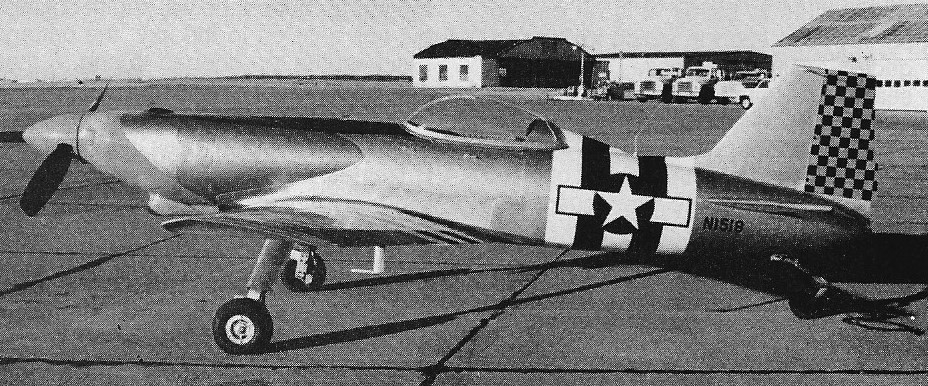
Piranha USA-1
Engine: Lycoming IO-360: 210 hp@ 2700 rpm
Prop: Hartzell C/S 2-Blade 74” Diameter
Wing Span: 18.5 ft.
Wing area: 70 sq ft (6.5 m2)
Overall Length: 18 ft. 4 in.
Empty Weight: 900 lbs
Gross Weight: 1440 lbs
Baggage Capacity: 30 lbs
Power Loading: 6.8 lbs/hp
Wing Loading: 21.3 lbs/sq. ft.
E. Flat Plate Area: 1.85 sq. ft.
Cabin Width Inside: 28 in.
Load Factor (g’s): +16, -16
Vne: 391 mph
Cruise Speed @ 2500 rpm/19 in./10,000 ft. 230 mph
Top Speed: 260 mph
Stall Speed Range (No Flaps Available): 130/105 mph
Rate of Climb @ Gross Wt. Sea Level: 1500 ft./min.
Economy Cruise Range (60 gal): 1700 approx.
Crew: one
Hardpoints: 1 with a capacity of 500 pounds (230 kg)
Rockets: 2 4-round 5.0-inch (127 mm) Zuni rocket pods
 All Aero