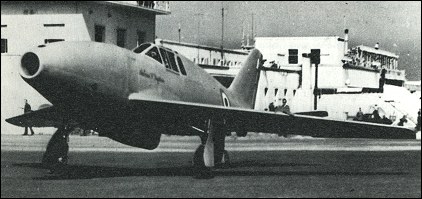
After tests with a 45° sweptback wing fitted to an otherwise standard Ambrosini S.7, thus nicknamed Freccia (Arrow), the designer Sergio Stefanutti designed the Sagittario (Archer) while he was director of SAI Ambrosini in Passignano sul Trasimeno in 1951.
Early studies for the new project, named Turbofreccia, instaled two Turbomeca Palas, positioned in the fuselage just behind the pilot’s seat, with air intakes n the wing roots. This arrangement was finally abandoned by Stefanutti who preferred the new Marboré II of 380 kg thrust. The engine is located in the front part of the fuselage, with a nose air inlet. The exhaust nozzle opens behind the trailing edge of the wing.
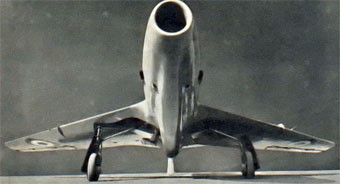
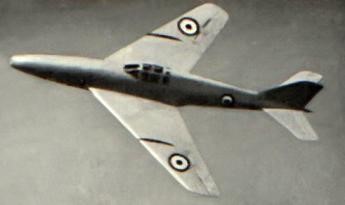
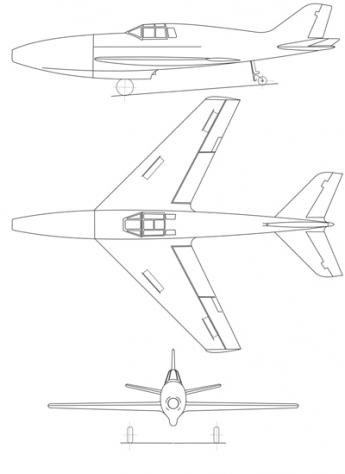
The construction is entirely of wood. The aircraft retained the basic fuselage of the Super S.7 married at a new 45 degree swept wing and swept tail surfaces. The retractable main landing gear comprises two front wheels and one rear wheel.
Intended mainly for aerodynamic research into transonic compressibility, the Sagittario flew for the first time on 5 January 1953. From this initial prototype Stefanutti subsequently developed the Sagittario II, which made its maiden flight on 19 May 1956, piloted by Guidantonio Ferrari, at Aviano.
Engines: 2 x Turbomeca Marboré II, 380 kg thrust
Wingspan: 7.50 m / 24 ft 7 in
Length: 9.32 m / 30 ft 7 in
Wing area: 16.60 m² / 157.15 sq.ft
Normal weight: 1750 kg
Loaded weight: 5070 lb
Maximum level speed: 560 Km / h / 349 mph at 13,123 ft
Time to 6000 m: 16 min 30 sec
Range: 354 mi
Endurance: 1h.35
 All Aero