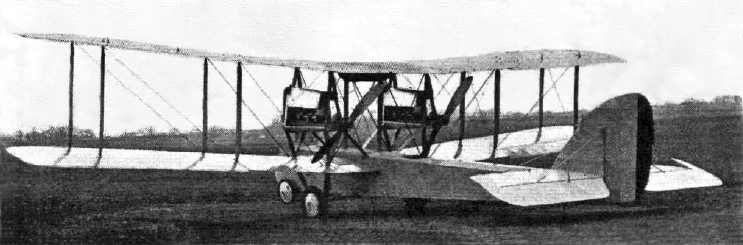
Under the designation Airco D.H.3, Geoffrey de Havilland designed a large two-bay biplane that was intended to fulfil a bombing role. With folding wings in order to save hangar space, and a conventional tailskid landing gear complemented by two wheels beneath the fuselage nose, extending well forward of the main wheels, to prevent it from bumping on the ground. Two Beardmore engines were mounted between the wings, directly above the main landing gear, and each drove a pusher propeller mounted on an extension shaft to clear the trailing edge of the wing. Accommodation was provided for a crew of three, the pilot in an open cockpit just forward of the wings, and the two gunners in individual cockpits, one in the nose forward of the pilot, and the other just aft of the wings.
A second prototype was built with more powerful Beardmore engines, each of 119 kW (160 hp), and with cutouts in the wing trailing edges in the area of the propellers so that the extended drive-shafts could be eliminated. This was designated D.H.3A, and almost immediately the War Office ordered 50. The order was later cancelled.
Neither of these aircraft was to enter production and both were reportedly scrapped within 12 months without seeing service use.
The DH 3 was also built under licence by Häfeli; some being operated as a single passernger airliner circa 1919.
Engine: 2 x Beardmore inline piston, 89-kW /120-hp
Maximum speed at sea level: 153 km/h / 95 mph
Climb to 1980m / 6,500ft: 23 minutes 30 seconds
Endurance: 8 hours
Cruise: 75 mph
Empty weight: 1805 kg / 3,980 lb
Maximum take-off weight: 2635 kg / 5,810 lb
Wing span: 18.54m / 60ft l0in
Length: 11.23m / 36ft l0in
Height: 4.42m / l4ft 6in
Wing area: 73.67m / 793 sq.ft
Armament: 2 x flexible 7.7-mm (0.303-in) Lewis guns, plus bomb load
 All Aero