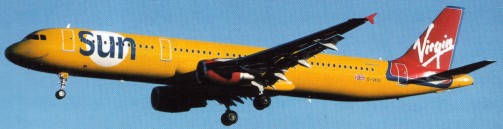
In November 1989 Airbus announced a stretched version of the A320-200, the A321 with a 44.51m long fuselage, a range of up to 5500km, and 186 to 220 passengers in a two-class layout.
The major change is the stretched fuselage, with forward and rear fuselage plugs totalling 22ft 10in (6.94 m), and strengthening of the undercarriage for higher weights, more powerful engines, a simplified and refined fuel system and larger tyres for better braking. A slightly modified wing with double slotted flaps and modifications to the flight controls allow the A321’s flying characteristics to closely resemble the A320’s. The A321 features an identical flightdeck to that on the A319 and A320.
The first large commercial post-war aircraft and first Airbus to be assembled in its entirety in Germany.
Lufthansa contracted for 20 aircraft on 5 July 1990 and took delivery of the first IAE V2530-AS-powered A321-100 on 27 January 1994.
The A321, 186-passenger stretch of the A320, was rolled out formally at the Deutsche Aerospace Airbus works on 3 March 1993 and made its first flight eight days later. The aircraft, powered by two IAE V2500s, took off from Hamburg on a 4 hr 40 min flight.
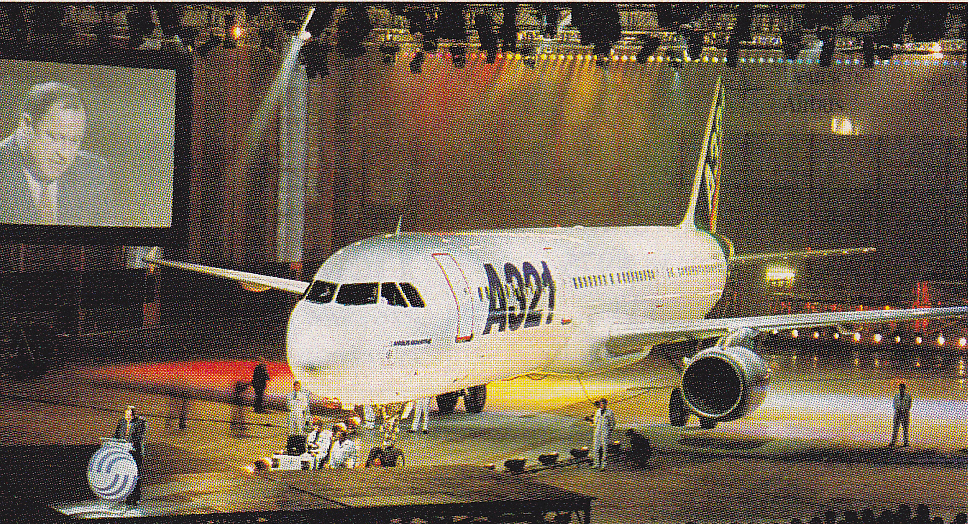
The A321 made its maiden flight in March 1993, and revenue service operations began in early 1994.
Air Lingus signed an agreement for four A321-200s in November 1997.
DRDO, the research and development organization of the Indian Ministry of Defense, acquired six Airbus A321s from Air India. DRDO was to convert three of them into Netra (Eyes) MkII AEW&C jets. These will be improved versions of the home-grown AEW&C system fitted on Embraer ERJ 145 platforms that India procured from Brazil. Two aircraft will be modified for the SIGINT/COMINT role. One aircraft is named ‘Anusandhan’ (Experiment) by the DRDO and will be used for testing technologies and sensors. The aircraft will be fitted with radars and sensors by the DRDO. Before that, the aircraft will be sent to France for refurbishment as per the IAF and the DRDO specifications. The whole project was expected to cost around Rs. 1.4 billion.
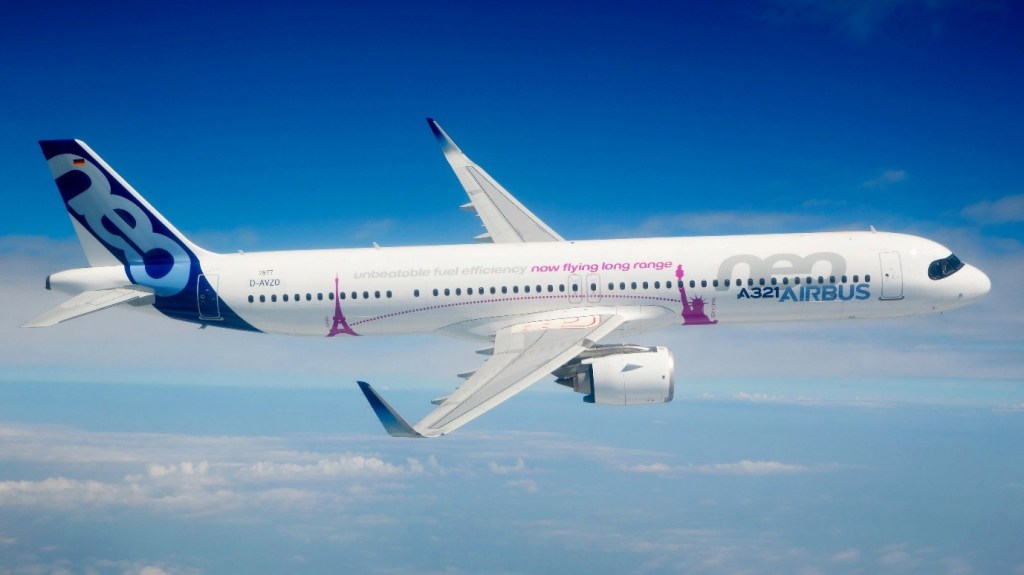
A321
Engines: 2 x CFM56-5B/P, 133-146kN
Take-off weight: 83000-93000 kg / 182985 – 205031 lb
Empty weight: 48100 kg / 106043 lb
Payload: 23400-25600kg / 51588 – 56439 lb
Wingspan: 34.1 m / 111 ft 11 in
Length: 44.5 m / 145 ft 12 in
Height: 11.8 m / 38 ft 9 in
Wing area: 122 sq.m / 1313.20 sq ft
Max. speed: 0.82M
Cruise speed: 0.78M
Range: 4150-5500 km / 2579 – 3418 miles
Crew: 2
Passengers: 185-220
Engines: 2 x International Aero Engines V2530-A5, 25,000 lb thrust
Wingspan: 111 ft 9.5 in
Length: 146 ft
Height: 38 ft 8.5 in
Wing area: 1320 sq.ft
Operating empty wt: 104,997 lb
MTOW: 182,984 lb
Max pax: 220
Max payload: 44,100 lb
Fuel cap: 23,858 lt
Max cruise: 488 kt
Econ cruise: 447 kt
Max speed: 0.82M / 320 kt
Service ceiling: 39,000 ft
Range (186 pax and res): 2350 nm
Crew: 2
Engines: 2 x CFM56-5B1 (or -5B2 option), 29,000 lb thrust (option 31,000 lb thrust)
Operating empty wt: 104,746 lb
MTOW: 182,984 lb
Max cruise: 488 kt
Econ cruise: 447 kt
Range (186 pax and res): 4260 nm
Wingspan: 111 ft 9.5 in
Length: 146 ft
Height: 38 ft 8.5 in
Wing area: 1320 sq.ft
Crew: 2
Max pax: 220
Max payload: 44,100 lb
Airbus A321LR
Length: 146 ft (44.51 m)
Height: 38.6 ft (11.76 m)
Cabin Width: 156 in (3.95 m)
Max Payload: 51,509 lb. (23,364 kg)
Range: 4,000nm (7400km)
Maximum seating: 206
 All Aero