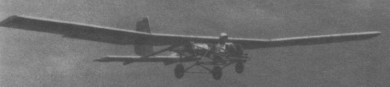
A side by side two seat single engined high-wing monoplane with conventional three axis control. Wing has unswept leading and trailing edges, and constant chord; conventional tail. Pitch control by elevator on tail; yaw control by fin mounted rudder; roll control by one third span ailerons; control inputs through stick for pitch/roll and pedals for yaw. Cantilever wing; wing profile NACA 23012; double surface. Undercarriage has three wheels in tail dragger formation; rubber suspension on all wheels. No ground steering (optional ground steering by differential braking). Optional brakes on main wheels. Aluminium tube framework, with optional pod. Engine mounted above wing driving pusher propeller. Wing and tail are made with stratified glass ribre/epoxy, vacuum molded; spar in carbon fibre.
Designed by Alain Erval, the prototype of the two seater Intermezzo made its first flight on the 14 August 1982 and went on next to a test flight programme and detail modification, leading to sales in April 1983.
This very original machine is a mixture of proven and classical solutions (NACA 23012 profiles for the wing and 0012 for the tail), combined with materials which are more common in gliding than in ultralights, such as layers of carbon fibre.
The central section of the Intermezzo wing has no dihedral and the outer sections of the wing set at 8 degrees. To make garaging easy, this wing demounts like a glider wing into three 13.2 ft (4.0 m) sections and the empennage can be removed from the two spars which carry it. They come off in two parts, the horizontal section being a unit and the vertical another. Thanks to these arrangements, the structure is completely foldable to ease towing on a trailer. Production Intermezzos are supplied with dual controls.
Another original point is that this machine is equipped as standard with fabric seats adjustable for the height of their occupants by laces; bucket seats are optional. It is fitted with a Hirth 493 cc engine (with electric start as an option), mounted by four bolts and with all electrical connections made via a single plug. This two seater is fitted with a tail dragger undercarriage. Production versions have an instrument panel with ASI, altimeter and rev counter.
Options include a pod with windscreen, an integral canopy with this assembly, the glide ratio increases from 12 to 15/1 at 37 mph (60 kph) and air brakes.
Engine: Hirth 2701RR 179, 45 hp at 3600 rpm
Propeller dia: 39 in, 1.0 m.
Reduction ratio: 1.8/1
Max static thrust: 265 lb, 120 kg
Power per unit area: 0.2 hp/sq.ft, 2.3 hp/sq.m
Fuel capacity mains: 10.6 USG, 8.8 Imp gal, 40.0 lt
Fuel capacity res: 5.3 US gal, 4.4 Imp gal, 20.0 lt
Length overall: 19.8ft, 6.0 m
Height overall: 7.2ft, 2.2m
Wing span: 41.0ft, 12.5m
Constant chord: 4.3ft, 1.3m.
Dihedral: 8 degs
Sweepback: 0 degs
Tailplane span: 13.1 ft, 4.0 m
Total wing area: 216 sq.ft, 20.0 sq.m
Total aileron area: 8.6 sq.ft, 0.8 sq.m
Fin area: 9.7 sq.ft, 0.9 sq.m
Rudder area: 3.2 sq.ft, 0.3 sq.m
Tailplane area: 43.2 sq.ft, 4.0 sq.m
Total elevator area: 12.9 sq.ft, 1.2 sq.m
Wing aspect ratio: 10.2/1
Wheel track: 6.7 ft, 2.0 m
Tailwheel dia. Overall: 4 in, 10 cm
Main wheels dia. Overall: 16 in, 40 cm
Empty weight: 287 lb, 130kg
Max take off weight: 662 lb, 300kg
Payload: 375 lb, 170kg
Max wing loading: 3.07 lb/sq.ft, 15.0 kg/sq.m
Max power loading: 4.7 lb/hp, 6.7kg/hp
Load factors: +6.6, 3.3 design
Max level speed: 87 mph, 140 kph
Never exceed speed: 124mph, 200kph
Max cruising speed: 81mph, 130kph
Econ. cruise speed: 71mph, 115kph
Stalling speed: 28mph, 45 kph
Max climb rate SL: 500 ft/min, 2.5 m/s
Min sink speed: 31 mph, 50 kph
Min sink rate: 240 ft/min, 1.2 m/s
Best glide ratio: 12/1 at 37 mph, 60 kph
Take off distance: 165ft, 50m
Landing distance: 165ft, 50m
Service ceiling: 12,500ft, 3800m
Range at ave. cruise: 311 mile, 500km
 All Aero