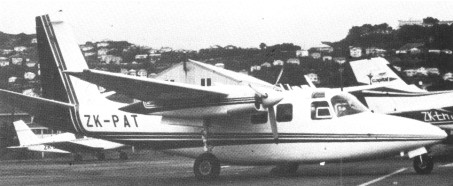
The first of the Commander twins was the 1958 model 500 with 230hp Lycoming O-540 engines. In 1960 the model 500A with Continental IO-470-M engines, redesigned nacelles, structural mods, new landing gear, and higher gross weight, was introduced. Both operated under 6A1.
Aero Design & Engineering 500 / 520 / 560 / Shrike Commander Article
The 500 was developed into the six seat Aero Commander 520 (the 520 indicating the total horsepower), certificated January 30,1952 and selling forty-three in that same year of production. From 1956 USAF and Army version of 520, 560, and 680 were designated L-26. All redesignated U-9 in 1962.
Approximately 150 model 520 were built. The 520 sold for $45,000, $66,000 in 1954. An upgrading of the powerplants followed in 1954, from the 260 hp Lycoming GO-435 engines of the Commander 520 to the 295 hp Lycoming GO-480 engines of the 560 in 1954. Gross weight lifted by 500 lbs to the 6,000 of the Commander 560 vertical tail surfaces were slightly swept. Approximately 150 model 560A were built with swept vertical tail, increased gross weight, and structural mods.
Three civil 520 went to the US Army, 52-6217 to 52-6219, as YL-26, later becoming U-9B.
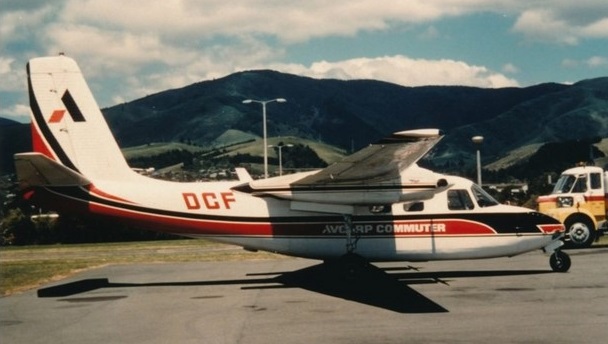
The 1960 model 500B, also under 6A1 featured Lycoming IO-540-B1A5 engines and a gross weight of 6750 lb.
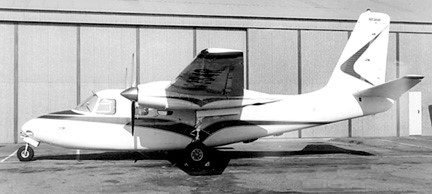
President Eisenhower took office and refused to use the “Independence”, Harry Truman’s airplane, as his Air Force One. Instead, he ordered a Lockheed Constellation as his primary aircraft. But for short trips into and out of his farm grass strip near Gettysburg, PA, the President needed something to operate from the short and unimproved landing area. Helicopters were not yet reliable enough. Driving took too long and snarled traffic. He told his chief pilot, Col. William Draper, to conduct an evaluation. His mission was to find a plane to go back and forth to the farm, and to make other short trips. The Colonel chose one of the most popular executive transports of the day, the Aero Commander 560A, and the Air Force ordered several for the President’s use. The Air Force designated the planes the L-26. Himself a pilot, Ike often took the controls of the Aero Commander, enjoying the opportunity to fly.
The fourteen U-4B (redesignated from L-26B) plus two L-26C (55-4647 and 55-4648) were the first lightplanes to earn the designation “Air Force One” and painted in the now standard blue-and-white color scheme.
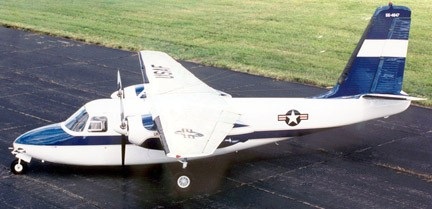
A fleet of six Commander L-26’s were assigned to the White House and used exclusively by President Eisenhower, Vice President Nixon, Cabinet and government officials, Secret Service, family and White House staff. This aircraft, 55-4638, was one of those original six. Two more were added a year later with turbocharged engines and assigned exclusively for Presidential use. This plane was used daily in the famous Gettysburg Airlift in 1955 and 1956, as well as the Greenbriar Airlift that hauled Ike along with the President of Mexico to North Carolina. Another seven L-26 aircraft were based in the Washington DC area and assigned to military units.
The sole USAF YL-26A 55-3815 of 1955 was a civil 560, later becoming U-4A.
A total of 34 L-26B were produced from 1952. Fourteen went to USAF; 55-4634 to 55-4646, and 57-1791, later becoming U-4B.
Approximately 70 model 560E were built with wingtip extensions and gross weight increase.
95 of the Aero Commander 500 were built.
The Aero Commander 500A and 500B later known as 500U, then Shrike Commander.
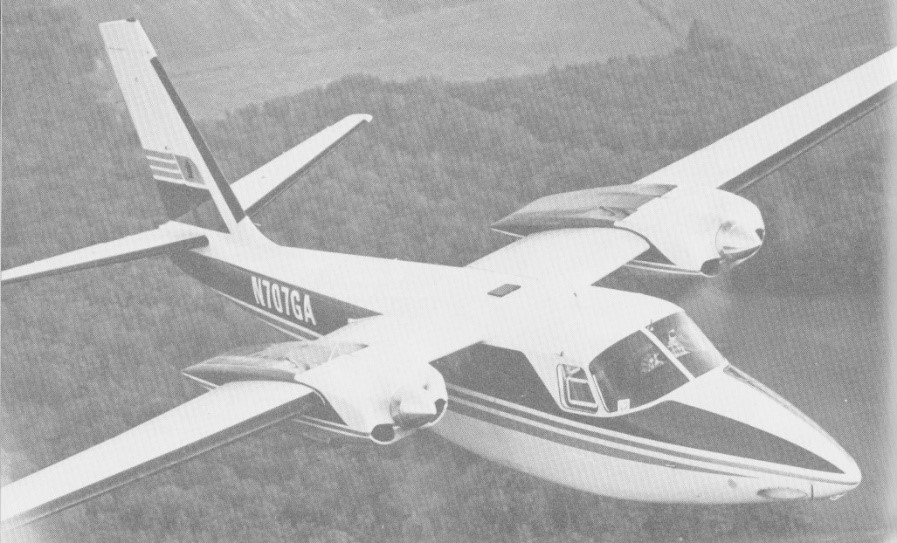
The 560F was a 1960 model.
The 1968 500S (6A1) incorporated more powerful engines, a redesigned pointed nose, some structural strengthening, pilot’s door and other equipment changes. Engines can be run at full throttle without restriction. All fuel tanks are interconnected, so no tank selection or cross-feeding is required. One-engine flight is managed without any particular fuss.
The 1964 500-U / Shrike Commander / Shrike Esquire (6A1) was the only twin in its class approved for limited aerobatics, as demonstrated by Bob Hoover in tours. Base price was $103,950.
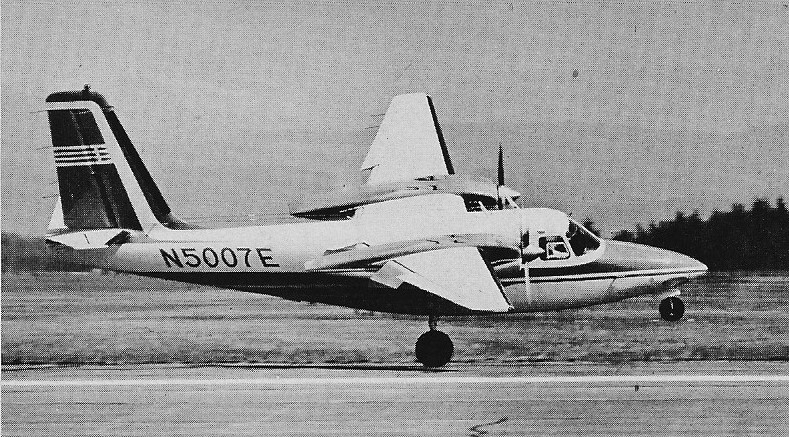
One distinguishing feature of the Rockwell Shrike is its eyebrow windows for improved cockpit visibility. The Shrike was certified in the utility category partly because the landing gear was designed for use on aircraft nearly twice the Shrike’s gross weight making landings on unimproved airstrips easy. The Shrike Commander 500S production was terminated 1980.
500
Engines: 2 x Lycoming O-540-A1A6, later -A2B, 230-hp
Seats: 6
Gross wt: 6,000 lb
500
Engines: 2 x Lycoming, 250-hp
Seats: 5-7
Gross wt: 6,000 lb
Empty wt: 3,850 lb
Fuel capacity: 156 USG
Top speed: 218 mph
Cruise speed: 205 mph
Stall speed: 63 mph
Initial climb rate: 1,400 fpm
Ceiling: 22,500 ft
Range: 1,100 sm
Takeoff distance (50ft’): 1,250 ft
Landing distance (50ft): 1,350 ft
500A
Engines: 2 x Continental IO-470, 260 hp
Seats: 6-7
Gross wt: 6,250 lb
Empty wt: 4,255 lb
Fuel capacity: 156 USG
Top speed: 228 mph
Cruise: 218 mph
Stall: 62 mph
Initial climb rate: 1,400 ft
Ceiling: 22,500 ft
Range: 1,225 sm
Takeoff distance (50ft): 1,210 ft
Landing distance (50): 1,150 ft
Colemill Super 300 / Aero Commander 500A
Engines: 2 x Continental IO-520-E, 300 hp
Seats: 7
Wing loading: 25.6 lb/sq.ft
Pwr loading: 10.9 lb/hp
Max TO wt: 6530 lb
Empty wt: 4200 lb
Equipped useful load: 1971 lb
Payload max fuel: 1035 lb
Range max fuel/ 75% cruise: 1148 nm/4.9 h.
75% cruise: 205 kt
Vmc: 85 kt
Stall: 72 kt
1.3 Vso: 94 kt
ROC: 1800 fpm
SE ROC: 290 fpm @ 101 kt
SE ceiling: 6,700 ft
Min field length: 2200 ft.
Fuel cap: 936 lb.
500B
Engines: 2 x Lycoming IO-540-B1A5, 290 hp.
TBO: 1,200 hr.
Gross weight: 6750 lb
500S
Engines: 2 x Continental, 290 hp.
Shrike Commander
Engines: 2 x Lycoming IO-540-E1B5, 290-hp
Wing span: 49 ft 0.5 in / 14.95 m
Length: 36 ft 9.75 in / 11.22 m
Gross wt: 6,750 lb / 3062 kg
Empty wt: 4,608 lb / 2090 kg
Top speed: 215 mph
Cruise speed 75% 9000ft/2745m: 203 mph / 176 kt / 326 kph
Stall speed: 68 mph
Initial climb rate: 1,340 fpm / 409 m/min
Range at 178 kt / 205 mph / 330 km, 45min res: 798 miles / 698 nm / 1525 km
Service ceiling: 19,400 ft / 5913 m
TO dist (50ft): 1,915 ft
Landing distance (50ft): 2,235 ft
Fuel capacity: 156 USG
Seats: 4-7
Cabin length: 10 ft 7.5 in / 3.24 m
Cabin width: 4 ft 4 in / 1.32 m
Cabin height: 4 ft 5 in / 1.35 m
Cabin capacity: 177 cu.ft / 5.01 cu.m / 500 lb / 227 kg
500U
Engines: 2 x Lycoming O-540-A1A6, later GO-480-C1B6, 290-hp
Wingspan: 49’1″
Length: 36’7″
Gross wt: 6,750 lb
Empty wt: 4,635 lb
Fuel capacity: 156 USG
Top speed: 230 mph
Cruise speed: 215 mph
Stall speed: 68 mph
Ceiling: 19,400 ft
Initial climb rate: 1,340 ft
Range: 1,230 sm
Takeoff distance (50ft): 1,375 ft
Landing distance (50ft): 1,235 ft
Seats: 4-7
520
Engines: 2 x Lycoming GO-435-A, 260 hp
Wingspan: 43’10”
Length: 32’0″
Useful load: 1318 lb
Max speed: 181 mph
Cruise: 165 mph
Stall: 56 mph
Range: 700 mi
Seats: 8
560
Engines: 2 x Lycoming GO-480, 295 hp
Span: 44 ft
Wing area: 242 sq.ft
Length: 34 ft 2.5 in
Height: 14 ft 9 in
MAUW: 6000 lb
560A
Engine: 270 hp Lycoming GO-480-B
Span: 44 ft
Wing area: 242 sq.ft
Length: 34 ft 2.5 in
Height: 14 ft 9 in
Empty weight: 3970 lb
Loaded weight: 6000 lb
Max speed: 209 mph at SL
Cruise: 200 mph at 10,000 ft
ROC: 1400 fpm
Range: 1048 mi
Seats: 5-7
580-E
1957
Engines: 275hp Lycoming GO-480D.
560F
Engines: 2 x Lycoming GSO-540, 340 hp.
YL-26 / U-9B
1952 Civil 520
Engines: 2 x 260hp Lycoming GO-435C
YL-26A
Civil 560
L-26B / U-4B
1952 Civil 560-A
Engines: 2 x 270hp supercharged Lycoming GSO-480
Wingspan: 49 ft
Length: 36 ft 9 in
Height: 14 ft 6 in
Range: 1,078 mi
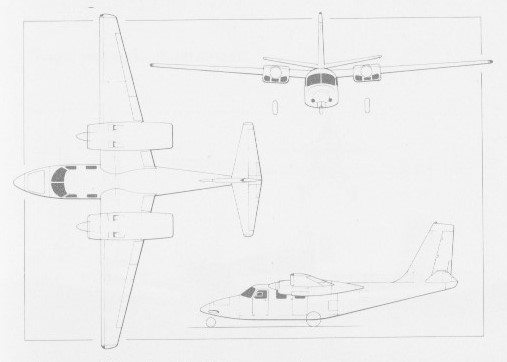
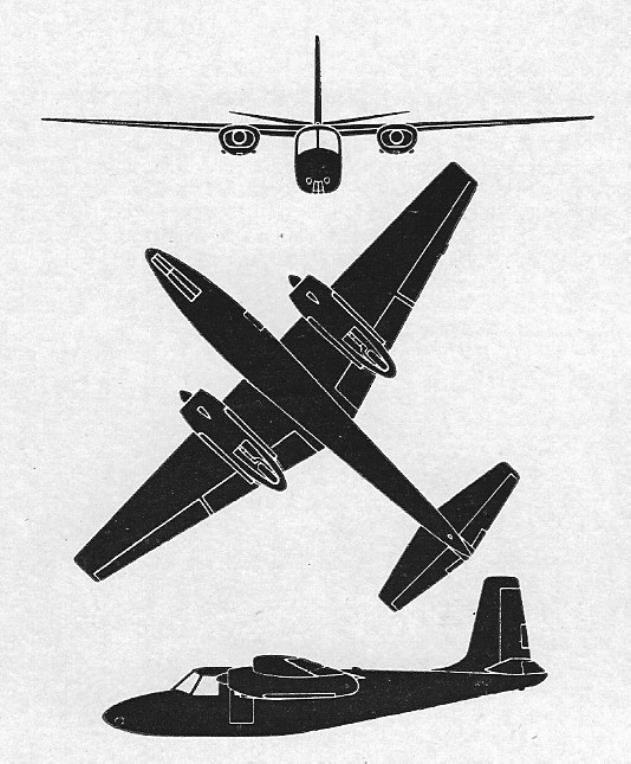
 All Aero