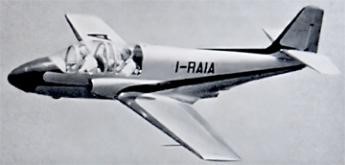
Postwar Caproni released the F5 in its new identity”Aero Caproni Trento”. It is a small low-wing monoplane, tandem two-seater.
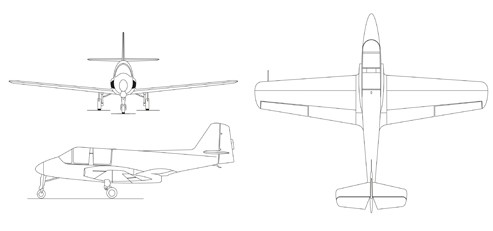
An all wood, simple structure, the air inlets have been designed so they do not interfere with the wing. The Caproni F-5 is a cantilever monoplane, with the lower surface flush with the ventral surface of the fuselage.
The fuselage shell is oval section and single box, covered with birch plywood. The fuselage is in two parts; the first comprises the cockpit (two seats in tandem) and supports the front leg of the undercarriage; the second contains the engine and the empennage. The two sections are joined by bolts. The tail is cantilever.
The landing gear is a retractable tricycle. The front has oleo-pneumatic damping, with steering controlled by the rudder. This wheel retracting rearward. The main gear has oleo- pneumatic damping, with hydraulic brake swingarm (the hinge rotates around the wing spar). The landing gear retraction is mechanical ; it is effected by means of a crank attached to the right front position.
The first flight was performed by test pilot Ernesto Zanlucchi on 17 May 1952 on the Milan Malpensa airport.
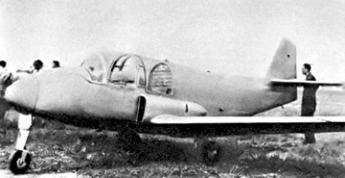
The same day as the first flight, Zanlucci and Vico Rosaspina, flew a range of acrobatics including looping and incipient spin.
The first tests made it possible to record the maximum ground speed at 360 kph, and at 3,000 m the F5 reached 315 km.h.
During the test dive conducted at 3,000 m, having two people on board, 520 km / h were reached without showing any vibration
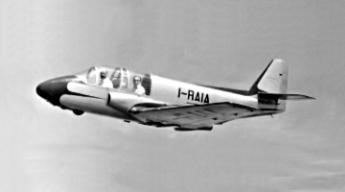
Engine: Turbomeca Palas, 150 Kgp
Wingspan: 7.65 m
Length total: 6.625 m
Height: 6.2 m
Wing area: 10 m²
Empty weight: 490 Kg
Max weight: 750 Kg
Max speed: 360 km
Range: 300 km
Ceiling: 8000 m
Time to 3,000 m: 11 min
Landing distance clean: 241 m
Landing distance flaps & brakes: 154 m
 All Aero