
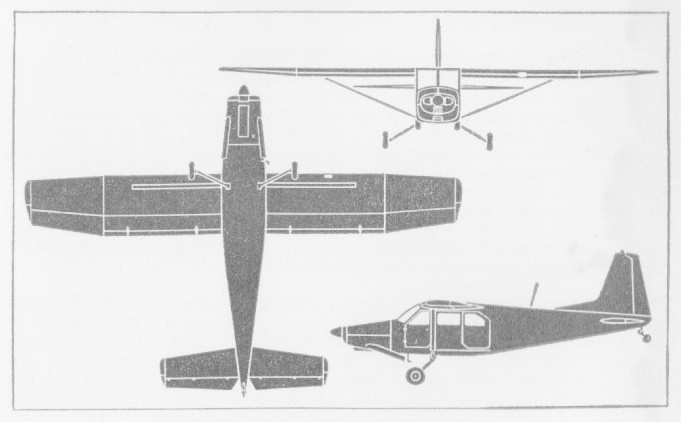
Under the Lockheed name, designed by the Mooney brothers as a single-engine light transport aircraft in the same general class as the Cessna 180-185, it made extensive use of castings and forgings for ruggedness and simplicity. The wing is NACA 23016 at the root and NACA 4412 at the tip. Lockheed flew the first prototype on 15 September 1959. As its massive overheads in its main factories would price the six-seat aircraft out of its intended market, Lockheed looked for licensees in other countries for production. A new factility was purpose-built for Lockheed-Azcarate SA at San Luis Potosi, Mexico, where the LASA-60 was produced.
The prototype Lockheed-Azcarate LASA 60 was certificated early in 1960, and registered in Mexico.
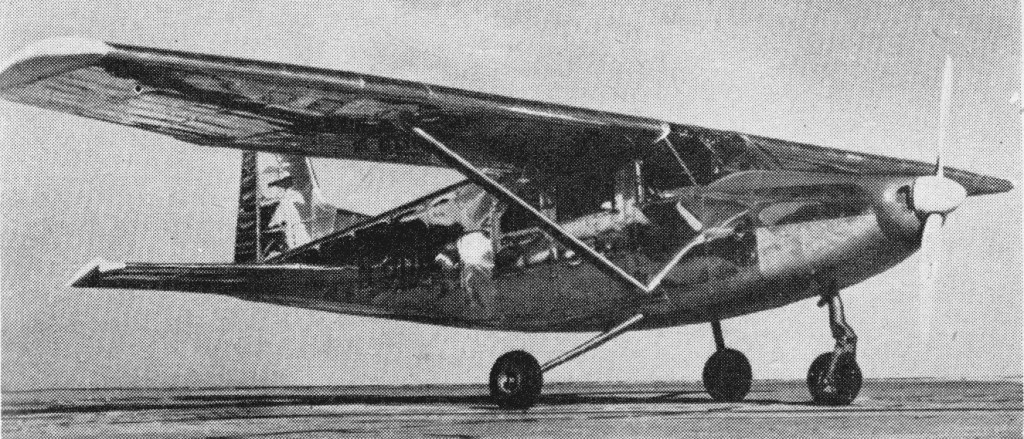
The first Mexican built LASA-60 flew on 21 March 1961. Eighteen LASA 60 built in Mexico in 1960 were for the Fuerza Aerea Mexicana until the withdrawal of that type in 1968 69. They were delivered to the Mexican Air Force’s No.209 Search and Rescue Squadron.
Plans for manufacture by Lockheed-Kaiser in Argentina were abandoned. The main licencee was Italy’s Aermacchi who acquired exclusive manufacturing rights.
Designated AL,60, the first Aermacchi-built aircraft flew on 19 April 1961, the basic production model being the AL 60B-1.
The AL 60B-2 was powered by a turbo-supercharged 260 hp Continental TSIO-470-B engine.
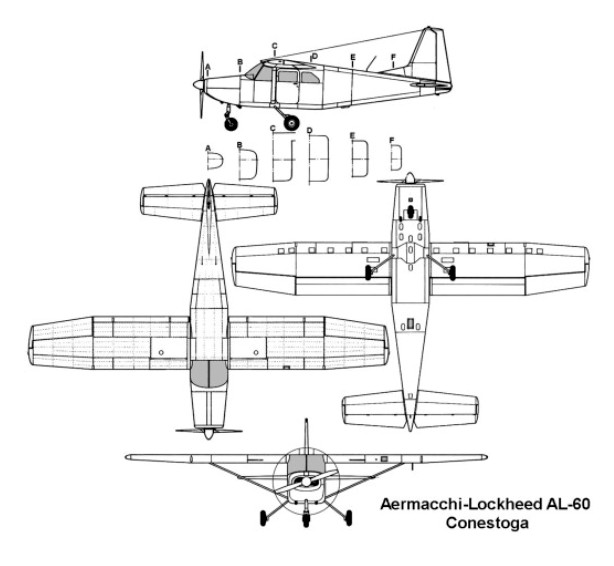
The AL.60C featured an up-rated engine and a parachute door. Flown for the first time in prototype form in early 1963, the AL 60C-4 the C-4 featured a tail wheel undercarriage and was the most powerful yet flown. The AL 60C-4 evolved to meet Italian Air Force requirements for parachute training, the dropping of supplies, and a sturdier undercarriage for rough field operation. Accommodating up to six persons, the AL 60C-4 has duplicate freight doors and an additional door for pilot entry. Apart from the doors, engine and undercarriage, the AL 60C-4 is essentially similar to other versions, and is of all metal construction with a D-spar torsion box wing structure and a semi-monocoque fuselage.
With a tail wheel, as the AL.60 C-5 Conestoga, which 10 were supplied to the Central African Republic from 1971 (two remaining in late 1997) and Mauretania (one remaining in late 1997).
The AL 60D-3 was powered by a 310 hp Continental GIO-470-A engine.
The AL.60F-5 version with nose wheel undercarriage was sold to the Rhodesian Air Force.
Other variants were made under license in South Africa.
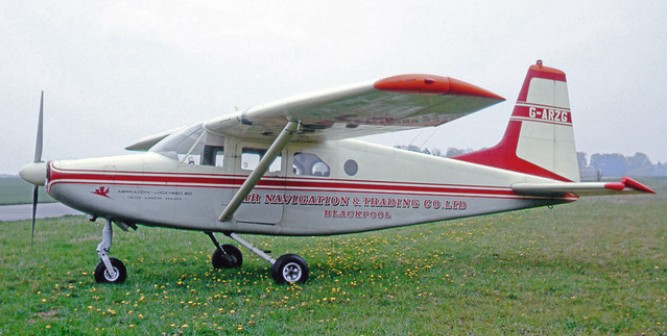
AL 60B-1
Engine: 250 hp Continental IO-470-R
Wingspan: 39ft 4 in
Length: 28 ft 1 in
Height: 10 ft 8 in
Wing area: 210 sq.ft
Empty weight: 2024 lb
Loaded weight: 3752 lb
Max speed: 148 mph at SL
Cruise: 75%: 140 mph
ROC: 890 fpm
Max range: 350 mi
AL 60B-2
Engine: 260 hp Continental TSIO-470-B
AL 60C-4
Engine: 340 hp Piaggio-Lycoming GSO-480-B1
Wingspan: 39 ft 4 in
Length: 28 ft 1 in
Height: 8 ft 6 in
Wing area: 210 sq.ft
Empty weight: 2344 lb
Loaded weight: 4200 lb
Max speed: 160 mph at SL
Max speed: 170 mph at 6500 ft
Cruise: 75%: 144 mph
ROC: 920 fpm
Service ceiling: 19,200 ft
Max range: 445 mi
AL.60F-5 Conestoga / Trogan
Engine: Textron Lycoming IO-720-A1A, 400 hp
Wing span: 39 ft 4 in / 11.99m
Aspect ratio: 7.35
Wing area: 210.44 sq.ft / 19.55 sq.m
Length: 28 ft 10.5 in / 8.8m
Height: 10 ft 10 in / 3.3 m
Empty wt: 2394 lb / 1086 kg
Operating wt: 2731 lb / 1239 kg
MTOW: 4500 lb / 2041 kg
Internal fuel: 75.9 Imp.Gal / 345 lt
Max payload: 1440 lb / 653 kg
Max speed SL: 135 kt / 156 mph / 251 kph
Max ROC SL: 1085 fpm / 331 m/min
Max cruise 10000ft: 125 kt / 144 mph / 232 kph
Service ceiling: 13,615 ft / 4150m
Econ cruise 5000 ft: 94 kt / 108 mph / 174 kph
TO run MTOW: 645 ft / 196m
TO to 50 ft MTOW: 1100 ft / 335 m
Ldg dist from 50 ft: 845 ft / 258m
Range: 560 nm / 645 sm / 1037 km
Seats: 8
 All Aero