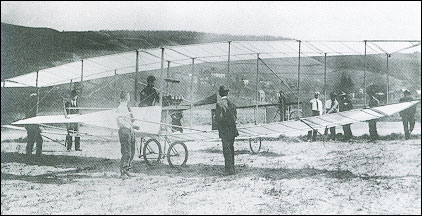
The second AEA aeroplane was White Wing, sponsored by Canadian F.W Baldwin, jointly designed by Baldwin and Curtiss. It was similar to Red Wing, except for the substitution of three wheels for the ice runners, and used the same Glenn Curtiss built engine.
“White Wing,” as a biplane with front elevator and rear stabilizers and rudder connected by wires to a four-axis steering wheel, and a rudimentary aileron system controlled by body motions of the pilot. Its three-wheel, rubber-tired undercarriage was Curtiss’ idea, a carryover from sidecar motorcycles.
An innovation was the addition of movable lateral control surfaces on all four wingtips that later came to be called ailerons. In principle, these had the same effect as the Wright’s wing-warping, but Curtiss claimed mechanical and control differences. The method of control reflected Curtiss’s motorcyle experience – a yoke embracing the pilot’s shoulders. When he wanted to bank for a turn, he leaned in the desired direction and the proper control movement was automatically applied.
After many reassessments and revisions, White Wing made four flights, the first on 18 May, 1908, with Baldwin at the controls. The distance covered was 85m at a height of 3m. The third flight was the longest, at 310m with Glenn Curtiss flying. White Wing crashed on 23 May after McCurdy had flown 167m.
Take-off weight: 274 kg / 604 lb
Wingspan: 12.87 m / 42 ft 3 in
Wing area: 37.9 sq.m / 407.95 sq ft
 All Aero