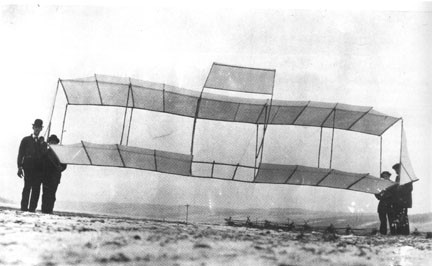
Alexander Graham Bell, inventor of the telephone, had a passionate interest in aviation and had experimented with scientific kites since 1891. He was also a good friend of the Dr. Samuel P. Langley, the builder of the unsuccessful Aerodrome. Bell was Langley’s successor determined to develop a practical airplane with the apparent blessing of the U.S. Army.
In September of 1907, he organized the Aerial Experiment Association to build a practical airplane.
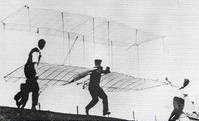
Initial plans were to build four flying machines, and for each member to personally oversee at least one project. The first of these was to be Bell’s kite, equipped with one of Curtiss’ motors. It took shape by December of 1908, but Bell wanted to test it as a glider before engine installation, so Selfridge, somewhat experienced in flight, was towed by a motorboat across a lake near Baddeck. The kitelike machine rose to an estimated height of about 170 feet, but then settled in the water still on tow, ruining many of its silk cells. While it was tediously undergoing repair, the group’s thoughts shifted to more conventional aircraft, such as those being flown in Europe at the time.
 All Aero