Coach building in the Wrecclesham village started before World War 1 at Warren’s works near the Cricketer’s Public House. In 1920 a company called Page and Hunt, run by Mr. Page who had been a painter at Warren’s, and financed by Mr. Hunt, who was in business in Castle Street, moved into larger premises by the railway bordering Weydon Lane. The firm specialised in custom built bodies which they fitted on Armstrong Siddeley and Daimler Chassis. The post war recession hit this firm badly and in 1928 they went into liquidation and Edward Dixon Abbott who had been the chief salesman for Page and Hunt, bought the business and changed its name to his own.
To keep the workforce busy during this difficult time he extended operations to work on commercial chassis and the refurbishing of older cars, including Rolls Royce. Under Abbott the company prospered and in the 30’s reverted again to building high quality coach-work on Rolls Royce, Daimler and Lagonda chassis specialising in convertibles.
During the early hours of 30th December 1935 a disastrous fire broke out in the saw mill and spread quickly to the body shop. About thirty new Frazer Nash, BMW and Talbot cars were destroyed. Temporary buildings were quickly erected while the factory was rebuilt. At this time there were about 110 employees on the payroll.
During the 30’s the firm branched out into the manufacture of light aircraft and gliders. This arose through the personal enthusiasm of Abbott who had been a World War 1 fighter pilot. Sir John Carden went into partnership with L. E. Baynes in 1930 to produce a one-off single-seat powered glider.
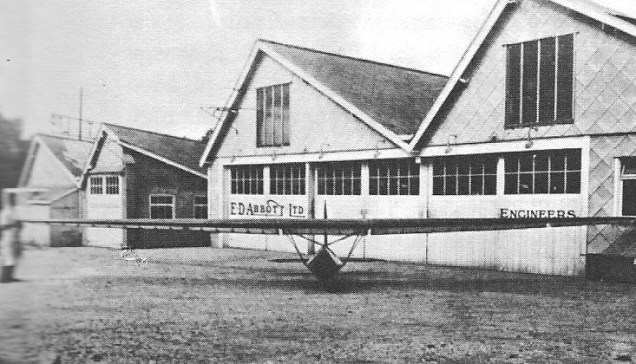
The Abbot-Barnes Sailplanes Ltd was established in 1931 when E.D. Abbot and L.E. Baynes entered into partnership to build Scud 1 and Scud 2 sailplanes of Mr Baynes design. The company was a subsidiary of A.E. Abbot Ltd of Farnham.
L.E. Baynes had originally started in the aircraft industry in 1916 with the Aircraft Manufacturing Co at Hendon, and later spent many years with Short Bros Lat at Rochester. In 1930 he designed the Scud 1 sailplane which was then built by Brant Aircraft Ltd (Baynes and Grant) at Croydon, Surrey. The Scud series was developed and extended by the Abbot-Baynes partnership and led to the Scud 3 / Auxiliary. This was designed to the requirements of Sir John Carden. He was a leading authority on tank design who had become interested in gliding but required a sailplane that could be put into the air without the help of others, so he suggested to Baynes the idea of a retractable engine. Carden also initiated the conversion of the Ford 10 car engine into a lightweight aero engine. Baynes installed one of these into a Flying Flea and several of these were built at the Abbot-Baynes factory incorporating many modifications by Baynes. Following several fatal accidents on the original type, a general ban was introduced and production of the Baynes version was discontinued.
During World War II the high grade skills of the work force were used to make aircraft components and by the late forties the firm was back into its original business with a series of high grade bodies on Rolls Royce, Bentley and Healey chassis.
By 1966 it was evident that Abbotts lacked the facilities to expand to cope with the increasing demand and Ford decided to take back the estate body production and to integrate it into their assembly lines at Dagenham.
Abbots had no other business to fall back upon so the firm went into liquidation.
 All Aero